
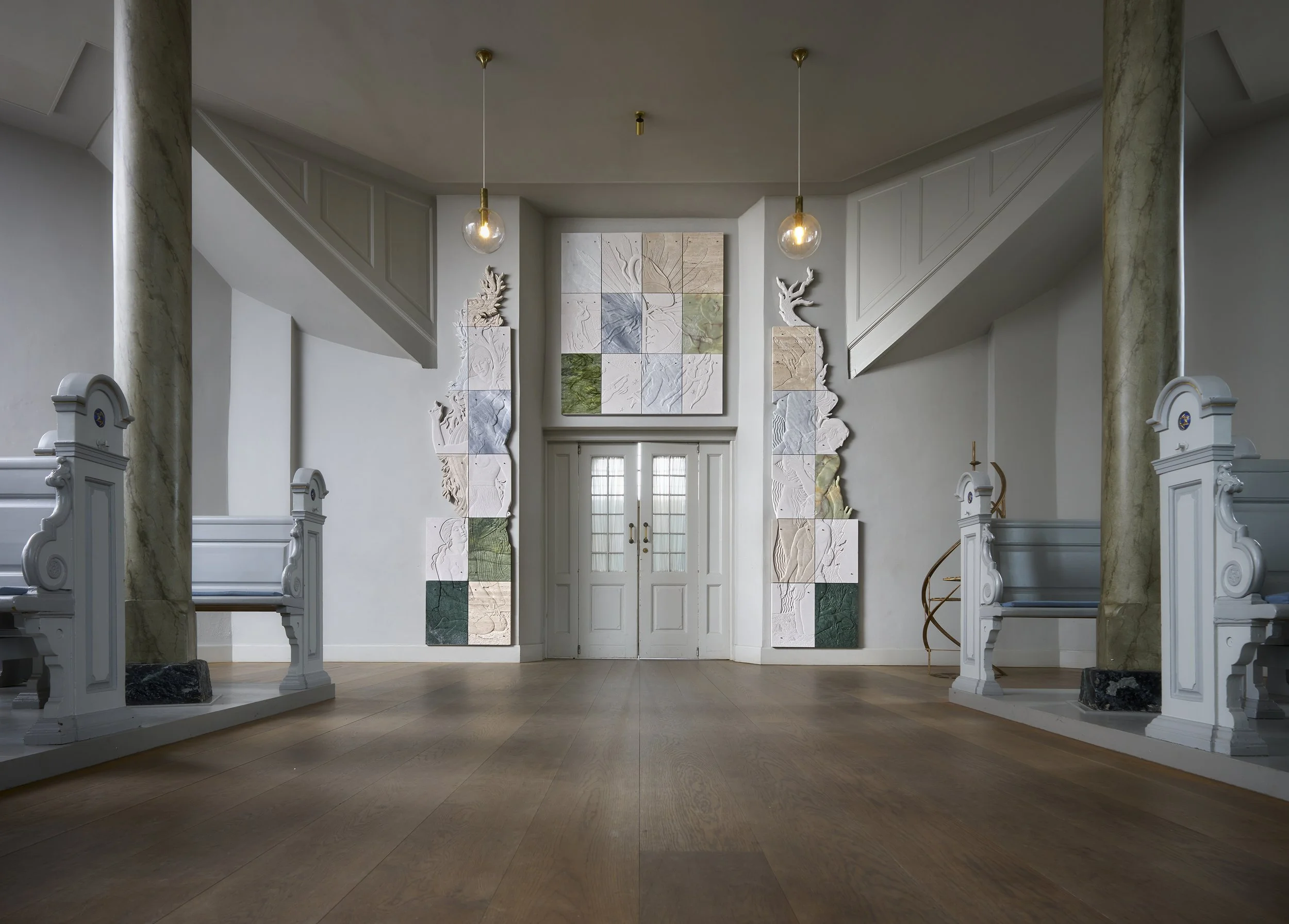
Through the Veins of the Stone: Sif Itona Westerberg
Image courtesy the artist.
Merging classical mythology with contemporary ecological fragility, the Copenhagen-based sculptor navigates the metamorphic boundary between the human body, industrial matter, and the deep time of Carrara marble.
The practice of Sif Itona Westerberg exists in a state of constant, quiet negotiation. To encounter her work is to witness a delicate friction between the ancient and the industrial, the organic and the cast, the mythical and the scientific. Based in Copenhagen, Westerberg has carved out a singular space in contemporary sculpture by utilizing materials that seem to hold opposing temporalities. Whether working in her signature aerated concrete, patinated bronze, or the geological weight of Carrara marble, her reliefs and free-standing forms suggest a world in which the boundaries between human anatomy and the wider ecosystem are becoming increasingly vague. The skin of her figures, often appearing in states of hybridity, serves as a porous membrane through which roots, branching cellular patterns, and industrial traces pass with an unsettling ease.
At Edition Solenne, we have had the privilege of working with Westerberg to translate this complex sculptural language into a series of intimate, highly technical editions. These works, including "Crux" in bronze and the recent "Heart", "Core", and "Cavity" series in hand-carved marble, represent a distillation of her career-long investigation into metamorphosis. By reinterpreting classical motifs through a lens of contemporary crisis, Westerberg does not merely look back at art history; she uses it as a forensic tool to examine the "Anthropocene", the current geological epoch where human activity dominates the planet's climate and environment. Her work is a reminder that while our technologies are new, our fears of transformation and the monstrous remain ancient and deeply rooted in the storytelling traditions of our ancestors.
The materiality of Westerberg’s work is fundamental to its impact. In her larger-scale practice, she often uses aerated concrete, a lightweight, industrial building material that carries a distinctively modern, sterile aesthetic. By carving into it with the precision of a classical stone-cutter, she creates a jarring but beautiful dissonance; the material of the suburban construction site is elevated to the status of a sacred frieze. In her collaborations with Edition Solenne, this investigation moves into the realms of cast metal and ancient stone, where the weight of the material provides a different kind of resonance. Each piece is a site of compression, where the historical weight of the Mediterranean sculptural tradition meets the urgent, shifting realities of the twenty-first century.
Origins and Education
Sif Itona Westerberg was born in 1985 in Copenhagen, Denmark, a city whose own architectural history is deeply informed by both neoclassical flourishes and the functionalism of modern Nordic design. She received her formal training at The Royal Danish Academy of Fine Arts (Det Kongelige Danske Kunstakademi), graduating in 2014. Her education in Copenhagen provided a rigorous foundation in sculptural technique and conceptual inquiry, but it was perhaps her personal background that most significantly shaped her philosophical approach to the studio. Raised within a feminist framework, Westerberg has spoken often about the need to view the challenges faced by women artists not as individual hurdles but as systemic conditions. This collective perspective informs her work's focus on vulnerability, the politics of the body, and the reclaiming of space.
During her years at the Academy and the decade following, Westerberg developed a fascination with the dualities of nature and culture. She observed how the human presence on Earth has moved from being mere inhabitants to being a "planet-changing force." This realization shifted her practice toward investigating the "geological brutality" of our current era. Rather than creating works that are purely representational, she began to build tactile abstractions that touch upon climate change, political ideologies, and the psychological effects of living within changing ecosystems. Her sculptural language became a way to explore how industrial traces are sedimented into both the earth and our own collective psyche.
The Practice: Mythology and Metamorphosis
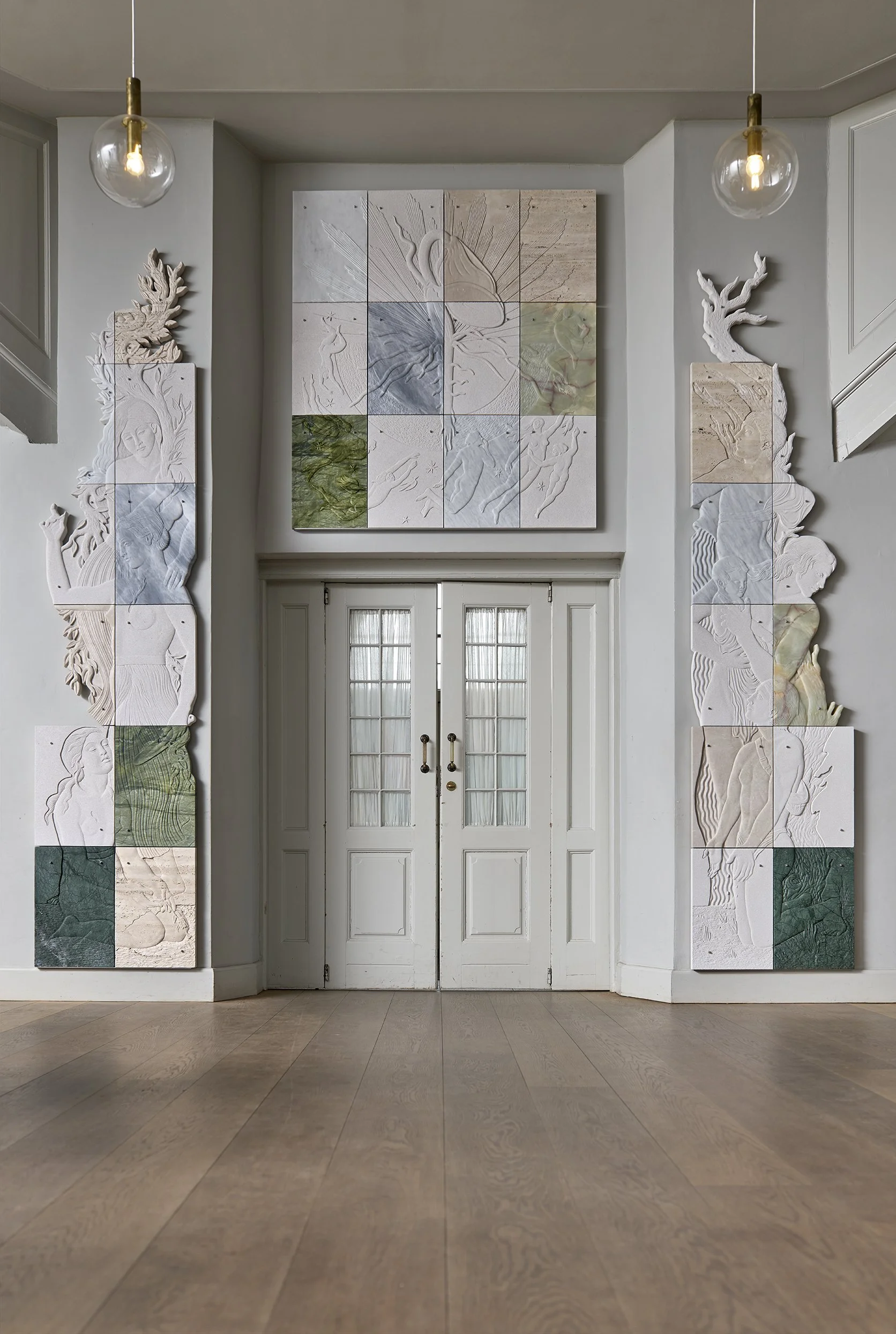
Westerberg’s broader oeuvre is characterized by a deep engagement with the "mythological fabric" that serves as the foundation of Western culture. She looks to ancient Greek sculpture not as a relic of a dead civilization, but as a living set of archetypes that continue to inform how we perceive the human form and its relationship to the divine. Her work frequently returns to the concept of metamorphosis, the moment where one state of being collapses into another. This interest is evident in major exhibitions such as "Yearn!" at Gether Contemporary (2022) and "Metamorphoser" at Sophienholm Kunsthal (2022). In these installations, figures seem caught in the act of becoming; a human chest might give way to branching coral, or a limb might dissolve into an industrial pipe.
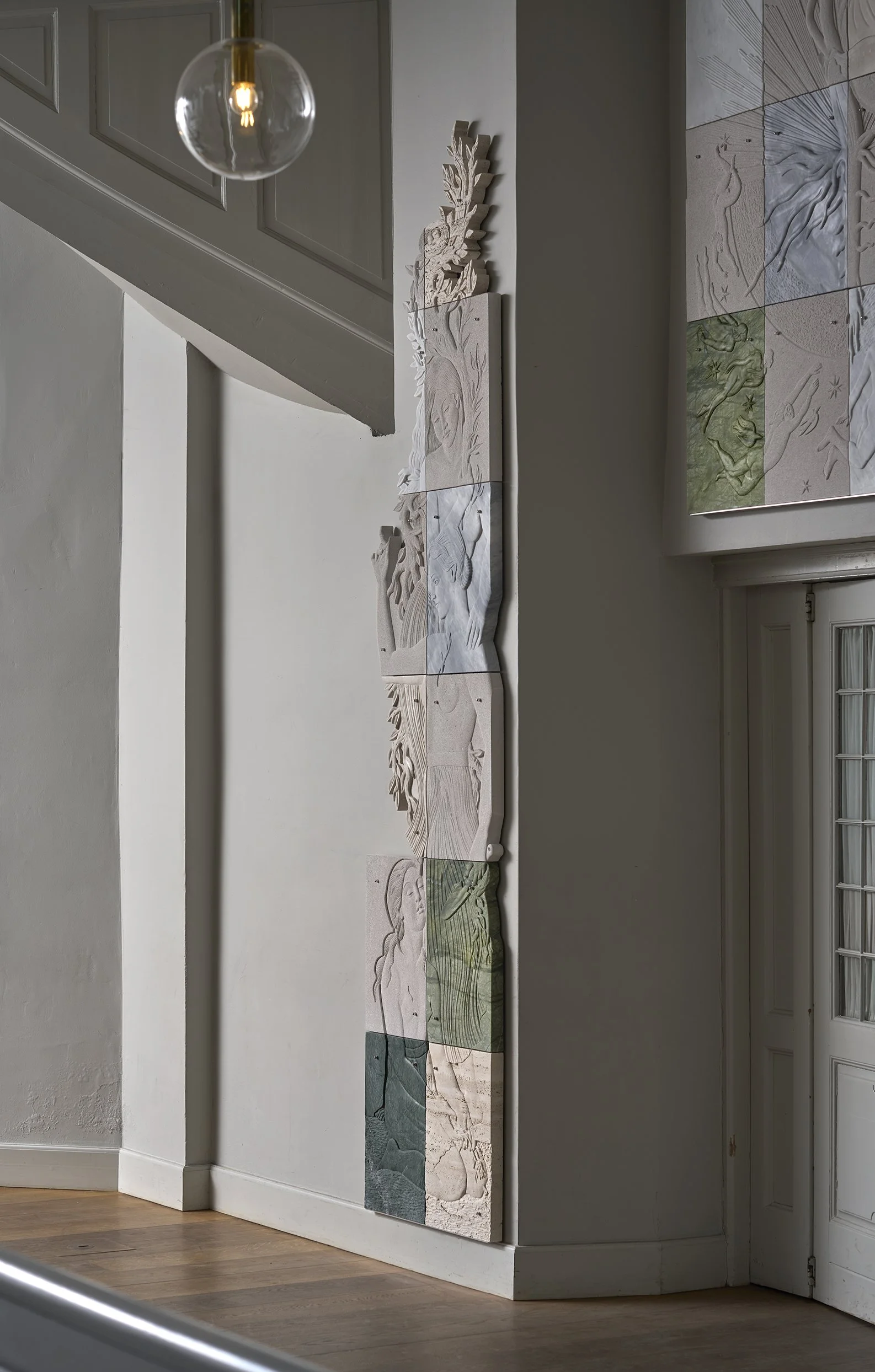
This obsession with transformation allows Westerberg to address the "monstrous" and the "divine" from a specifically modern perspective. She is interested in the cyborg, the hybrid, and the chimera, beings that defy traditional categorization. By utilizing the relief format, she connects her work to the long history of narrative stone carving found on the pediments of temples and the walls of cathedrals. However, the narratives she tells are those of the Anthropocene. Her reliefs depict the quiet, often violent integration of technology and nature, asking what it means to be a part of an ecosystem that is shifting too rapidly for the human mind to fully grasp. This investigation has led her work into prestigious collections, including the ARoS Aarhus Art Museum, where her pieces stand as testimonials to the evolving definition of contemporary sculpture.
Westerberg’s approach is also deeply spatial and installation-based. She does not merely place objects in a room; she seeks to create an "enveloping setting" that encourages the viewer to linger. For Westerberg, time is the most valuable commodity in the modern world, and her goal is to reward the viewer's attention with layers of detail that only reveal themselves upon closer inspection. This might involve the subtle texture of aerated concrete, which mimics the porosity of bone, or the complex patina of a bronze cast that suggests both biological decay and industrial oxidation. The physical presence of her work is intended to activate the viewer's intuition, moving beyond the limitations of verbal language to touch upon the complex emotional landscape of our time.
References and Influences
When discussing her influences, Westerberg points to a lineage of artists who have pushed the boundaries of their respective mediums while maintaining a deep commitment to the social and environmental issues of their day. She specifically cites Danish artists Anne Marie Carl Nielsen and Sonja Ferlov Mancoba, two pioneering women whose contributions to art history are only recently being fully recognized and contextualized. From Mancoba, one might see shadows of the semi-abstract, totemic forms that appear in Westerberg's more vertical sculptures. From Nielsen, there is a clear connection to the study of the living organism and the mastery of classical technique used to express vital energy.
Her references also branch out into contemporary peers who work with the intersection of the biological and the technological. She has noted an affinity for the work of Marguerite Humeau, Sandra Mujinga, and Camille Henrot, among others. These artists, like Westerberg, are engaged in a form of world-building that uses sculpture to speculate on future ecologies. The influence of literary and philosophical sources is also palpable; her work resonates with the ideas of Donna Haraway regarding the collapse of the boundary between human and machine, or the writings of Timothy Morton on
I try to explore different aspects of the manmade climate change, that we are experiencing today. And how it affects us to be a part of an ecosystem that is rapidly changing, where the boundaries between human, nature and technology is becoming more and more vague.
In Conversation: The Sculptor's Logic
In interviews, Westerberg often speaks about the "internalized problems" that female artists face in the contemporary landscape. She is candid about the challenges of balancing a high-intensity career with the realities of motherhood, a topic that remains stigmatized in a way that it rarely is for male colleagues. She views her dedication to her work as a form of resistance against the expectation that women should lower their professional ambitions once they have families. For Westerberg, the act of "taking up space" and "being too loud" in her work is not just an aesthetic choice but a political necessity. Every time she breaks a norm regarding how a woman is supposed to behave or work, she sees it as "taking one for the team," continuing the road paved by her predecessors.
The labor of her practice is physically demanding. Carving into aerated concrete or stone requires a high degree of precision and endurance. She has described the process as one of constant discovery, where the material itself dictates the final form. In her collaboration with master carvers like Massimo Galleni in Pietrasanta, Italy, this solo effort becomes a collective one, drawing on centuries of Italian craft tradition. This dialogue between the artist's initial vision and the expertise of the carver is central to the editions produced with Edition Solenne. It ensures that while the works are part of a series, each one retains a unique character, shaped by the specific veining of the marble and the subtle variations of the hand-finishing process.
The Works with Edition Solenne
One of the most foundational releases with Edition Solenne is "Crux" (2022). This dual-piece sculpture, cast in blue and brown patinated bronze, serves as a bridge between the shadowy, unacknowledged aspects of humanity and the rational, seen world. Bronze as a medium is historically significant; it is a material that will outlast its creators, holding a detail and gravity that few other alloys can match. "Crux" invites the viewer into a conversation about what the combination of classical form and modern aesthetics means in our current era. The two parts of the sculpture create a dialogue of contrast, the cool tones of the blue patina against the warmth of the brown, the smooth surfaces against the intricate details of the cast. It is an examination of humanity's suppressed side, bringing the "subcultural" into the light of the gallery space.
The making of "Crux" at the Fonderia Artistica Mariani in Italy emphasizes the work's connection to heritage. Using the traditional lost-wax and vacuum-shell methods, the foundry captures the finest surface details of Westerberg's original model. This process ensures that every ridge and hollow is a physical record of the artist's hand, now frozen in metal. "Crux" encourages the viewer to look at the "here and now" through the lens of deep history, asking how the ecologies and relationships of the modern era are reflected in the weight and permanence of bronze. It is a work of reconstruction, assembling classical imagery into a new, complex configuration that speaks to the fractured nature of contemporary identity.
In 2025, Westerberg expanded her collaboration with Edition Solenne through a series of three marble reliefs: "Heart", "Core", and "Cavity". Carved from Carrara Bianco C Marble, these works move the focus inward, exploring the physiological and emotional landscapes of the body. "Heart" (2025) is perhaps the most tender of the trio. It depicts a serene upper body intertwined with branching organic forms that rise across the chest like a second, living nervous system. At 35h x 25w cm, the relief turns the marble into a living membrane. The soft curves of the lips and the quiet upward movement of the forms suggest a state of relational openness and renewal. Westerberg avoids sentimentality by framing the heart as structural rather than decorative; it is the emotional infrastructure of the human being.
The technical execution of "Heart" is a marvel of removal. Working with Massimo Galleni’s studio in Pietrasanta, each 35 cm tall block is carefully reduced using point and tooth chisels before being refined with rasps and drills. Because marble is worked only by subtraction, the piece represents a months-long conversation with stone that has been in the ground for millions of years. This temporal depth is essential to the work's meaning. "Heart" addresses the first aperture toward aliveness and sensitivity, presenting the emotional chamber not as a site of vulnerability to be protected, but as an engine of responsiveness. The subtle variations in the marble's natural veining ensure that each of the 12 editions is a singular exploration of this emotional threshold.
I think that I am trying to create a visual and intuitive language for some of the questions that are too large and complex to answer with words alone.
"Core" (2025) shifts the focus toward formation and metamorphic potential. In this relief, a face in profile leans toward a flowing form that could be air, water, or the very breath of life itself. The wavelike carving across the marble surface suggests a continuous rhythm where the lines of the figure's hair merge into the elements. If "Heart" is about openness, "Core" is about the site of compression, the internal engine where change is consolidated under pressure. The denser sculptural planes and concentrated openings in the stone convey a sense of motion held in suspension, as if the figure is on the verge of a profound internal shift.
The materiality of "Core" reinforces the idea of internal growth. Carrara marble, known for its consistency and historical use by the likes of Michelangelo, provides the perfect canvas for Westerberg’s precision. In this work, the stone is made to feel both fragile and enduring. The carving process, which moves from roughing out the mass to the final fine finishing (matte or honed), reveals the marble's inherent depth. Each piece in the edition of 12 carries its own unique markings, reminding the collector that the work is a collaboration between the artist's intent, the master carver’s skill, and the geological history of the Apuan Alps. "Core" represents the kernel of the self where internal change is forged, making it a powerful meditation on the endurance of the individual within a changing world.
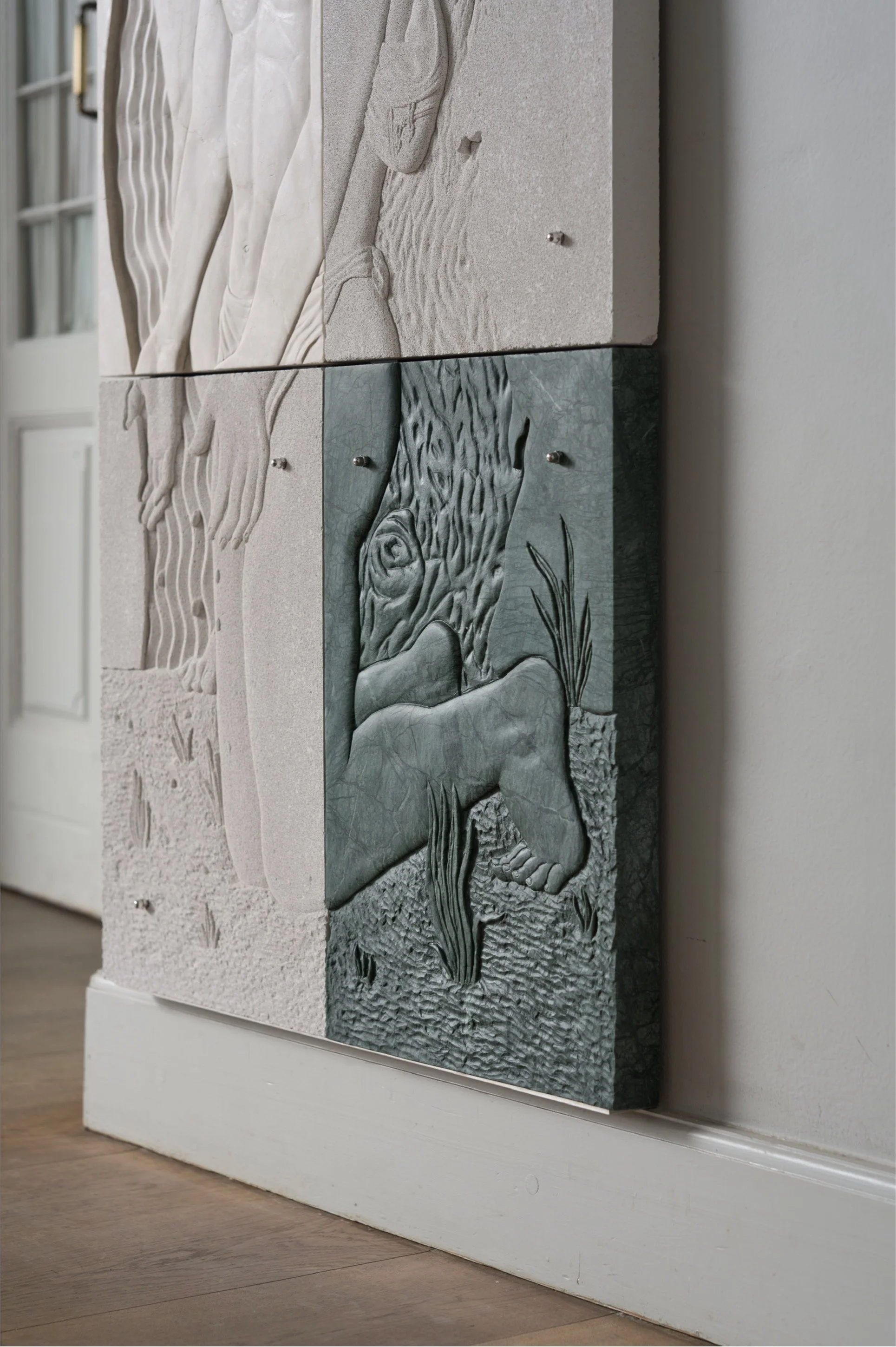
Finally, "Cavity" (2025) investigates the "hollow interior" filled with archaic memory and long-buried connections. In this relief, a hand meets an organic structure that seems to grow directly from the marble. The touch is light, almost cautious, as if discovering something that has been dormant for eons. The cellular patterns and branching forms suggest fossils or roots, creating a sense of an interior archive where instinct and ancestry are stored. This work challenges the idea of the cavity as an empty or negative space; instead, it is portrayed as generative and potent, a site of latent energy and sedimented traces.
The deeper recesses and darker voids in "Cavity" illustrate the archaic dimension of Westerberg’s thought. The hand-carving process is particularly visible here, as the master carvers in Pietrasanta translate the artist's sketches into deep, cavernous forms that catch the light in dramatic ways. At 35h x 25w cm, the work is a dense concentration of theme and material. It captures a moment where the living form presses outward against the stone that contains it, representing the tension between our ancient evolutionary roots and our contemporary desire for emergence. Like its sister pieces, "Cavity" is accompanied by a signed certificate of authenticity and is part of a strictly limited edition, ensuring its place as a collectible work of significant art-historical and material value.
Closing: The Quiet Coda
The work of Sif Itona Westerberg serves as a vital record of our current moment, yet it remains profoundly connected to the deep time of the earth. By choosing to work with materials that demand slow, careful labor, she resists the fast-paced, disposable nature of modern culture. Her editions with Edition Solenne, whether the patinated bronze of "Crux" or the Carrara marble of the 2025 series, are more than just objects; they are sites of contemplation. They ask us to consider the traces we leave behind, the ways our bodies are intertwined with the planet, and the myths we must construct to understand our place in a shifting landscape.
As her career continues to evolve through major museum exhibitions and international collaborations, Westerberg remains committed to the "visual and intuitive language" that has defined her practice from the start. Her sculptures do not offer easy answers to the complexities of climate change or gender politics. Instead, they provide a physical setting where we can stay a little longer, allowing our intuition to work and our bodies to feel the weight and texture of the world. In the hands of Westerberg, the ancient stone and the industrial cast are reclaimed as tools for empathy and awareness, ensuring that the metamorphosis of the human spirit continues to be recorded in the most enduring materials we have.


