

A Contemporary Archaeology of the Everyday: The Patinated Bronze World of Rose Eken
Image courtesy the artist.
From the smoke-filled subcultures of the Danish punk scene to the meticulous bronze foundries of Pietrasanta, Rose Eken explores the fragility of existence through the objects we leave behind.
In the quiet, concentrated air of a Copenhagen studio, Rose Eken works at the intersection of memory and materiality. Her practice, which has spanned over two decades, is often described as a form of contemporary archaeology. Rather than excavating ancient ruins, Eken finds her treasures in the detritus of the present: the crushed cigarette pack, the discarded oyster shell, the spent lighter, and the haunting stillness of a fallen bird. These objects, frequently overlooked or discarded as waste, are rendered with a profound sensitivity that elevates the ephemeral into the eternal.
Eken’s work is a testament to the power of the hand. While she is widely recognized for her mastery of ceramics, her recent explorations into bronze marked a significant shift in her oeuvre, one that Edition Solenne has been proud to facilitate. By casting these fragile, hand-molded forms into an alloy that will outlast the viewer, Eken creates a paradox of weight and lightness. Her sculptures do not merely represent objects; they represent the ghosts of human activity, the lingering traces of a night out, a meal shared, or a moment of quiet reflection. To hold an Eken bronze is to feel the gravity of a specific history, captured and preserved through the alchemy of heat and metal.
Origins and the Spirit of Resistance
Born in Copenhagen in 1976, Rose Eken grew up in an environment where art and performance were woven into the fabric of daily life. Her mother, a teacher of opera singers, and her brief exposure to the world of art publishing through Hans Jørgen Brøndum, provided an early understanding that creativity was not a hobby but a vital necessity. Eken has frequently stated that art, for her, is akin to breathing, a fundamental requirement for navigation through the world. This necessity led her away from traditional educational paths at a young age.
At sixteen, Eken abandoned the standard school system to immerse herself in the practical and gritty reality of the Copenhagen underground. Working as a stage technician at Café Teateret and arranging sound and light for bands in the city's punk scene, she developed an aesthetic grounded in subculture. This era of her life, characterized by DIY ethics and the raw energy of live performance, remains a primary reservoir for her imagery. The ashtrays, beer bottles, and equipment that populate her work are not random choices; they are the artifacts of a formative rebellion, a world where she felt better standing on the edge, looking into the abyss, rather than existing within the safe, standardized boxes of mainstream society.
Making art is what makes me happy, it is like breathing.
Her formal education eventually took her to Scotland, where she attended an art academy, but her method remained idiosyncratic. She recalls that as a child, she did not have a dollhouse; instead, her entire room was a sprawling installation of miniature scenarios. This impulse to shrink the world, to control and document it through scale, has persisted. Whether working in painting, ceramic, or bronze, Eken maintains a fascination with the balance between the precise and the non-precise, allowing the marks of her hands to remain visible as a record of her labor and presence.
The Practice: Memory as Material
Eken’s broader oeuvre functions as a sprawling archive of material culture. She is known for her large-scale installations that present hundreds of individual ceramic objects together to form a larger narrative. These works often reference the rock and roll lifestyle, featuring amplifiers, duct tape, drum kits, and leftovers from after-parties. In documenting these ephemeral moments in clay, she halts the process of decay. Ceramic is a fragile material, yet it is also incredibly durable; it does not rot or rust. By selecting it, Eken gives permanence to objects that were designed to be used once and thrown away.
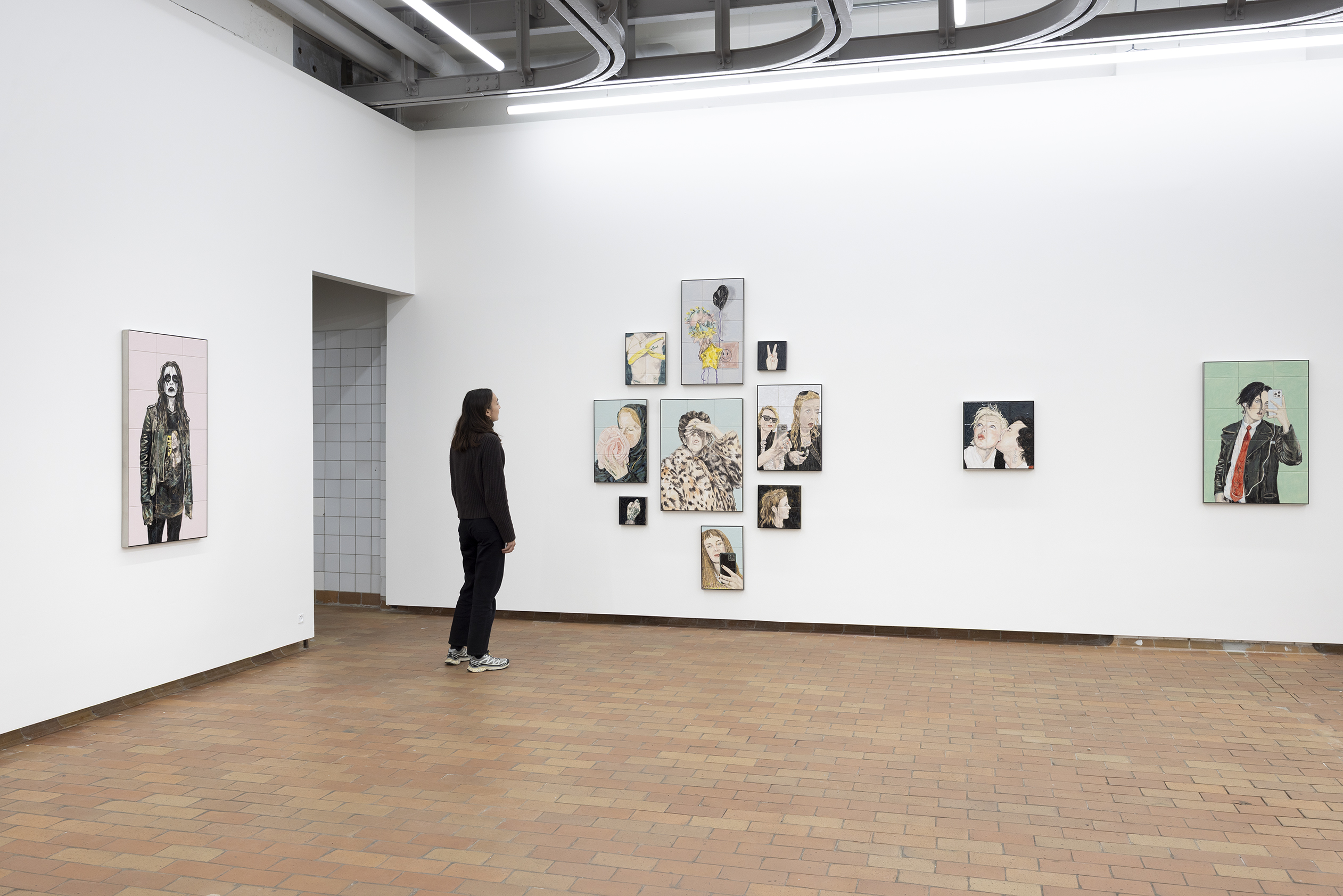
Her exhibitions, such as "LAnd the Forests Dream Eternally" at Eighteen gallery in 2023, or her site-specific installations in Tivoli Gardens for CHART in 2024, demonstrate her ability to scale her intimacy. In Tivoli, her bronze sculptures were placed within an historic amusement park, challenging the viewer to find these small, quiet interventions amidst the noise and spectacle. This contrast is at the heart of her practice: the tension between the monumental nature of the sculpture and the mundane, or even dark, nature of the subject matter. To see a "Metalhead" or a piece titled "Death" in glazed ceramic is to see the heavy iconography of subculture softened by the artist's touch.
In Conversation: The Logic of the Object
In discussions about her work, Eken often highlights her desire to let the viewer inhabit her pieces. "I use objects, put them together and try to tell stories," she noted in a recent interview, adding that these stories are told through other people's memories. By presenting an ashtray or a partially eaten lemon, she provides a prompt. Every viewer knows the smell of a cigarette, the acidity of a citrus fruit, or the weight of an oyster shell. Her sculptures act as vessels for these sensory recollections.
This process requires an intense work ethic. Eken often works eighty hours a week, a pace she suggests is necessary to keep up with the demands of her own curiosity. It is not just about the creation of the form, but the mastery of the chemistry behind it. When transitioning to bronze, she collaborated with the Fonderia Artistica Mariani in Pietrasanta, Italy. This storied foundry, established in 1952, provided the technical expertise required to translate her hand-molded waxes into the permanent language of metal. In this environment, the traditional lost-wax method becomes a bridge between Eken’s contemporary archaeology and the history of classical sculpture.
I use objects, put them together and try to tell stories, but really through other people's memories.
The Works with Edition Solenne
The collaboration between Rose Eken and Edition Solenne resulted in a series of bronze sculptures that encapsulate her primary themes: the passage of time, the beauty of the discarded, and the specific aesthetics of the punk subculture. These works are finished with a unique black and green patina, a chemical treatment that gives the bronze a weathered, historical quality, as if they have just been pulled from the earth or the bottom of a canal.
The work "Dead Bird" (2022) is perhaps the most somber and poetic piece in the collection. Measuring approximately 20 x 9 x 10 cm, it depicts a small avian form in the state of final repose. Eken captures the stiffened feathers and the delicate, limp neck with a degree of focused detail that avoids sentimentality while embracing pathos. In casting this moment of death in bronze, she creates a permanent memorial to a fleeting life. The black and green patination highlights the texture of the feathers, creating a play of light and shadow that suggests both the coldness of the metal and the softness of the original creature. It is a work that investigates the fragility of life, turning a small tragedy into a monumental object of contemplation.
This sculpture, like all in the series, was produced at Fonderia Mariani using the lost-wax process. Each edition of the 30 + 4 Artist’s Proofs carries slightly different patinated nuances, ensuring that while the form is shared, each piece has its own life. The "Dead Bird" serves as a memento mori, a traditional art-historical trope that Eken revitalizes through her contemporary lens. It asks the viewer to slow down and acknowledge the cycles of nature that continue unnoticed in the background of our hectic lives.

In "Oysters and Cigarettes" (2022), Eken moves toward the social detritus of the night. This sculpture, measuring 14 x 5 cm, juxtaposes the high-culture association of oysters with the grit of the punk rock scene symbolized by the cigarettes. It is a portrait of a specific kind of decadence. The organic, craggy surface of the oyster shell is rendered with incredible fidelity in the bronze, contrasting with the smooth, cylindrical shapes of the cigarettes nestled against it. The green patina pools in the crevices of the shell, mimicking the look of aged copper or seaweed, further grounding the work in a sense of time passed.
The piece functions as a relic of a rebellious era. By memorializing these objects, Eken acknowledges the enduring legacy of the punk movements she inhabited. It is not just a representation of food and tobacco; it is a narrative of a night spent in conversation, in music, and in the defiance of health and safety. The weight of the bronze gives these light objects a physical presence that demands they be taken seriously as historical evidence. It suggests that even our most hedonistic or wasteful moments are part of the cultural tapestry that deserves preservation.
Continuing this exploration of the table's remains is "Oysters and Lemons" (2022). Similar in scale at 15 x 5 cm, this work leans closer to the tradition of the Dutch still life, particularly the 'pronkstilleven' which often featured expensive foods and exotic fruits in states of partial consumption. However, Eken’s version is stripped of the oils and colors of painting, rendered instead in the dark, heavy language of classical sculpture. The lemons, half-squeezed and discarded, are elevated here to the status of icons. Eken’s craftsmanship focuses on the texture of the citrus skin and the interior pulp, details that are perfectly captured by the vacuum-shell casting methods of the Mariani foundry.
This work encourages a radical slowing down of perception. Eken’s journey to turn an everyday object into an enduring sculpture is a plea to the viewer to enjoy the little moments that are often experienced and immediately forgotten. The lemon and the oyster are symbols of the senses, of taste and smell, now frozen eternally in bronze. The black and green patina acts as a unifying layer, stripping away the literal colors of the food to focus the eye on form, volume, and the visceral reality of the metal itself.
Finally, "Ashtray and lighter" (2022) serves as the most direct link to the "contemporary archaeology" aspect of Eken's practice. Measuring 12 x 4 cm, this work captures the most ubiquitous remains of a certain lifestyle. The ashtray, filled with cigarette ends, and the nearby lighter represent a pause in time. It is a reminder of how collective habits change, how the once-common sight of a filled ashtray has become a relic of a previous era. The rugged patina gives the piece a rustic, almost ancient aesthetic, as if it were a Roman artifact found in a dig, rather than a common household item from the late 20th century.
Through this piece, Eken acknowledges the smaller things that tell the larger story of human interaction. The sculpture is individualized by its patina, which reacts differently to the contours of the ashtray and the lighters. It is a remarkable example of how Eken uses bronze to add a layer of gravity and history to the trivial. In her hands, the ashtray is no longer waste; it is a profound artistic expression, a testament to the fact that nothing is too small to be worthy of our attention or our memory.

Closing: The Weight of Witness
Rose Eken’s work does not shout; it observes. Her choice to collaborate with Edition Solenne on these bronze editions indicates a desire to see her observations take on a life that spans centuries. While her ceramic works carry the charm of the miniature and the immediacy of the hand, the bronze works carry the weight of the witness. They are silent observers of our culture, documenting the things we smoke, the things we eat, and the things that die quietly in the grass beneath our feet.
By moving between the subcultural underground and the refined traditions of European sculpture, Eken carves out a space that is uniquely her own. She remains the child who builds worlds in her bedroom, the technician who understands the mechanics of the stage, and the artist who recognizes that in the smallest, most broken object, there is a story waiting to be told. Through her partnership with the Mariani foundry and the stewardship of Edition Solenne, these stories have been cast in metal, ensuring that the ephemeral memories of the punk scene, and the natural world, remain accessible to those who are willing to look, to slow down, and to remember.


