

The Infinite Thread: A Conversation with Landon Metz
Image courtesy the artist.
Through rhythmic repetition and an acute sensitivity to architecture, the American abstract painter Landon Metz negotiates the tension between the perceptible and the void.
For Landon Metz, the canvas is not a boundary but a threshold. Since emerging into the international art scene, the New York-based painter has developed a visual language that feels both ancient and startlingly current. His practice, characterized by thin washes of dye on raw, unprimed canvas, eschews the heavy impasto of traditional oil painting in favor of a method that is closer to calligraphy or alchemy. There is no bravado in the mark; instead, there is a quiet, rhythmic persistence that invites the viewer to enter a state of calm awareness. The work does not shout for attention; it waits to be discovered, much like the architectural nuances of the galleries it inhabits.
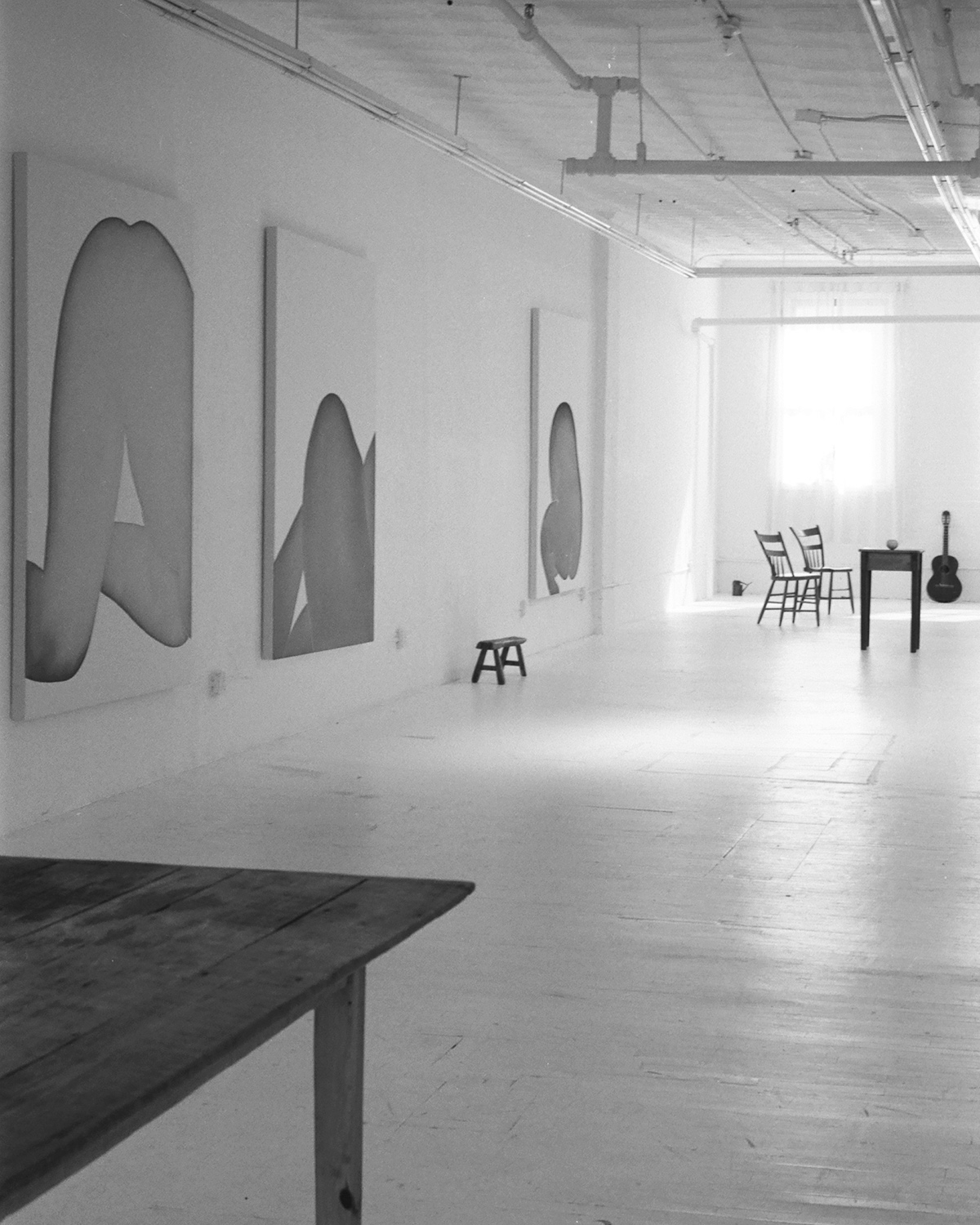
Metz has long been fascinated by the relationship between the object and the space around it. To encounter a Metz installation is to experience a carefully choreographed dialogue between form and void. His paintings often wrap around corners, stack floor-to-ceiling, or leave intentional gaps that allow the wall itself to become a participant in the composition. This sensitivity to site, which he defines as site-responsive, allows his work to function not as a static image but as a dynamic intervention. Whether working on a monumental scale that engages the entire body or a localized scale that demands intimate scrutiny, Metz maintains a singular focus on the purity of the gesture.
In his collaboration with Edition Solenne, Landon Metz has translated these ethereal concepts into the weight of bronze. This transition from the liquidity of dye on canvas to the permanence of cast metal represents a profound evolution in his exploration of materiality. The resulting works do not merely mimic his painted forms; they re-contextualize them, using the reflective properties of mirror-polished metal to integrate the environment in a way that paint never could. It is a continuation of a career-long inquiry into what it means to make something, to leave a mark, and to hold space for the silence that follows.
Origins and the Compulsion to Create
Born in 1985 in Phoenix, Arizona, Landon Metz grew up in an environment where the vastness of the desert landscape perhaps informed his early understanding of scale and openness. However, his initial creative outlet was not found at the easel, but through music. The rhythmic structures of sound and the discipline required for performance provided an early foundation for the temporal and sequential nature of his later visual art. The transition from musician to painter was not a sharp break but an intuitive journey, guided by a sense that he was destined for a creative output that he describes as his entire life.
A pivotal moment occurred when Metz was only twelve years old. An older mentor, an artist from his community, moved to New York City to study painting. The stories that filtered back to Arizona about the New York art scene, the intensity of the studio practice, and the philosophical weight of the discourse shifted young Metz’s understanding of art. It ceased to be merely a hobby and became a vocation, a serious pursuit tied to the history of the medium and the vibrancy of the city. This early exposure to the mythology and reality of the art world instilled in him a reverence for the process that persists today.
The Practice: A Mode of Inquiry
To understand Metz’s oeuvre, one must understand his method. He employs a soak-stain technique, a process popularized by Helen Frankenthaler, where thinned acrylic washes are poured directly onto raw, horizontal canvas. This method is unforgiving; the dye bleeds into the fibers, and the artist has only one shot to get the form right. There is no layering over mistakes, no reworking of the surface. This performative, one-shot approach requires a deep connection between the artist’s physical movements and the behavior of the material. In his studio, Metz often works on the floor, supporting his weight with his arms in a process he likens to yoga, moving around the canvas to guide the flow of the wash.
The resulting biomorphic forms appear deceptively simple. Usually repeating in sequences, these shapes suggest cells, clouds, or valleys, yet they remain resolutely abstract. By using multiple canvases to form a single work, Metz creates a sense of narrative without a beginning or an end. This seriality is key to his practice; he views his work as a long, unfolding thread where each series is indebted to the previous one. This was evident in his London exhibition, Love Songs, where the repetition of form across the gallery walls created a rhythmic cadence that mirrored the musicality of his youth.
Being an artist is all I know, it’s my life.
References and Cinematic Stillness
Metz’s work is deeply grounded in art history, yet it draws equally from avant-garde music and philosophy. One of his most cited influences is John Cage, specifically Cage’s seminal work 4.33. Just as Cage used silence to highlight the ambient noise of the concert hall, Metz uses the blank space of the canvas and the architecture of the gallery to highlight the environment. He is fascinated by the tension between reality and our perception of it, filtered through the limitations of our senses. By intentionally leaving gaps in an installation, he allows for a unification of form and formlessness, where the perceptible internal reality meets the imperceptible potential of the void.
This interest in the functional gesture extends to his use of color. Metz resists didactic explanations for his palette, preferring to let the hues exist on their own terms. There is a sense of freshness to his colors, as if they are coming into existence for the first time on the raw canvas. This economy of decision-making ensures that every mark is functional and open, maintaining what he calls the perfect whole of the blank canvas while still fulfilling his role as an artist who must eventually choose to act.
In Conversation: Site and Authorship
In a recent discussion with ArtReview at Waddington Custot, Metz elaborated on his distinction between site-specific and site-responsive work. While site-specific art is often reactive to a single setting, Metz’s site-responsive approach acknowledges the inherent properties and predispositions of a space without permanently altering them. He notes that every room, whether a gallery, a church, or a home, comes with a set of expectations and a predetermined story. His goal is to shed light on things that are already there, helping the viewer to re-contextualize their surroundings through the presence of his motifs.
This philosophy extended to a moment of revelation during his installation in London, where the 4:5 ratio of his canvases was found to correspond perfectly with the architectural proportions of the gallery wall, a detail that even the gallery’s long-term director hadn't fully realized. This kind of environmental synergy is what Metz strives for. It is not about the artist imposing his will on the space, but about a collaborative emergence of meaning that involves the artist, the work, and the viewer.
I do my best to have every gesture be as functional as possible.
The Works with Edition Solenne
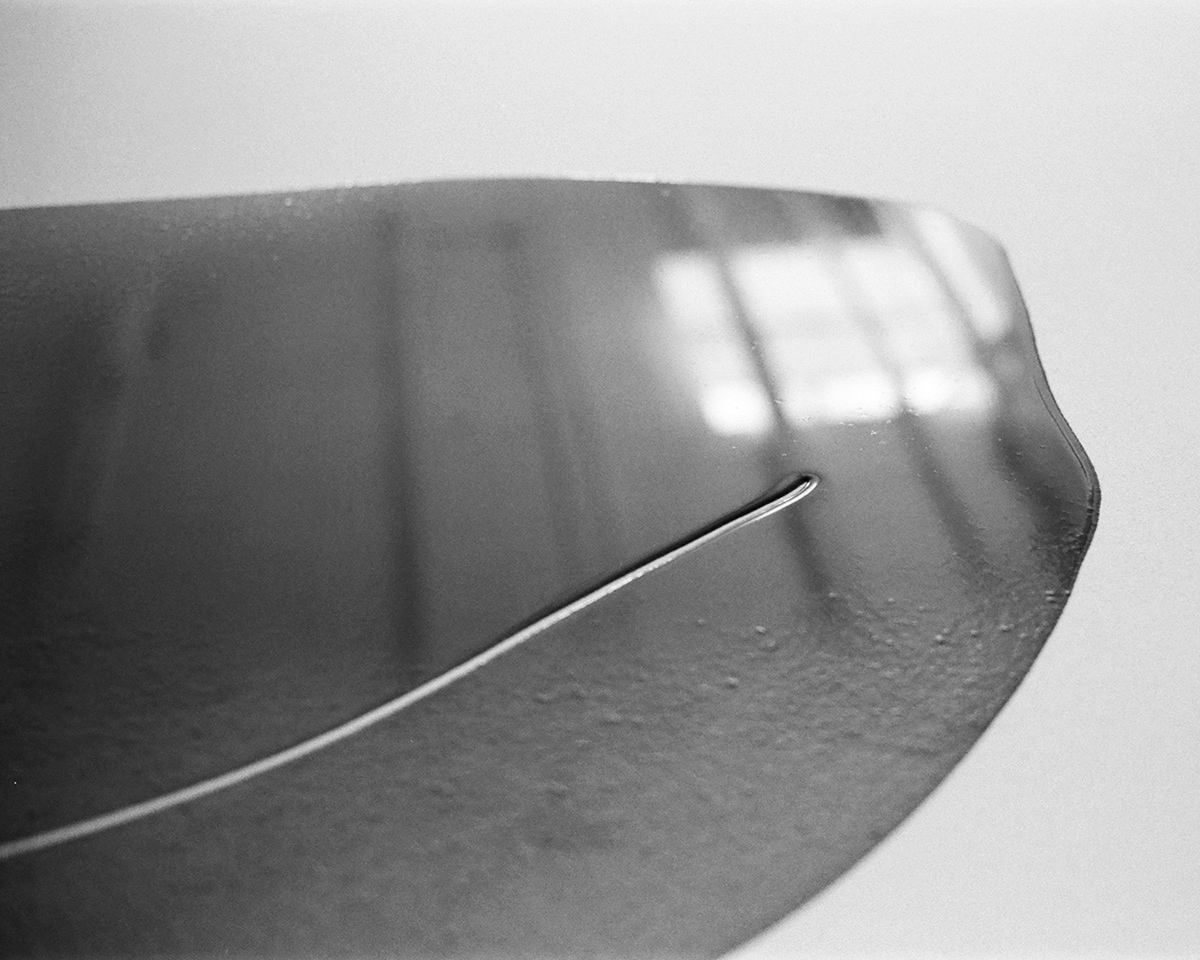
Transitioning from the fluidity of paint to the permanence of monument, Landon Metz created 'Untitled' (2022) for Edition Solenne. This mirror-polished bronze sculpture represents a significant moment in the artist's narrative, translating the rhythmic and meditative essence of his two-dimensional paintings into a three-dimensional object. The sculpture, measuring 25 x 25 x 15 cm, carries the familiar biomorphic curves of his painted forms, but adds a layer of tangible materiality that invites interaction. By moving away from the wall, Metz allows his inquiry into spatial dynamics to occupy the center of the room, forcing a different kind of physical awareness from the collector.
The choice of mirror-polished bronze is essential to the work's conceptual success. Because the surface is highly reflective, the sculpture is never the same twice; it absorbs and re-projects the light, colors, and objects of its environment. In a home, it might reflect the grain of a wooden table or the shifting light from a nearby window; in a gallery, it catches the movement of passersby. This makes the sculpture truly site-responsive, as it literally includes the surrounding objects in its own form. It acknowledges the ever-changing nature of abstract art, proving that even a solid metal object can possess the formlessness and potentiality that Metz cherishes in his blank canvases.
The making of the piece at Fonderia Artistica Mariani in Italy adds a layer of heritage and gravity to the work. Using the traditional lost-wax casting method, the foundry captured every nuance of Metz's original model. The process involves creating a ceramic shell around a wax replica, which is then melted away to be replaced by molten bronze. This ancient technique ensures that each of the thirty editions preserves the exact density and surface detail of the artist's hand. Even though the final finish is a high-gloss polish, the weight of the cast bronze provides a grounding presence, an alloy designed to outlast the viewer and become a permanent record of the artist's gesture.
Finally, the sculpture serves as a tool for grounding the often disorienting concepts of abstraction in a familiar environment. By placing a Metz work on a personal surface, the collector enters into the dialogue of authorship that the artist so frequently discusses. The piece requires a viewer to be complete, and its reflective surface ensures that the viewer is always, quite literally, part of the work. It is a fragment of a larger narrative, a physical manifestation of the thread Metz has been pulling since his early days in Arizona, now hardened into a reflective form.

Closing: The Resonance of the Mark
Landon Metz continues to push the boundaries of what abstract painting and sculpture can achieve by doing remarkably less. In a world characterized by a fast-paced hullabaloo, his work offers a visual aesthetic for an alternative mode of being, one rooted in stillness and tranquility. Whether he is working with the transparency of an acrylic wash or the opacity of polished bronze, his focus remains on the functional gesture and the infinite potential of the space it occupies.
As his practice evolves, the core remains the same: an intuitive journey of inquiry. By humbly learning from each process and trusting the material to speak, Metz has created a body of work that is as much about the viewer's own physicality as it is about the artist's hand. In the collaboration with Edition Solenne, we see this inquiry reach a new level of permanence, offering a moment of quiet reflection in an ever-changing world.


