
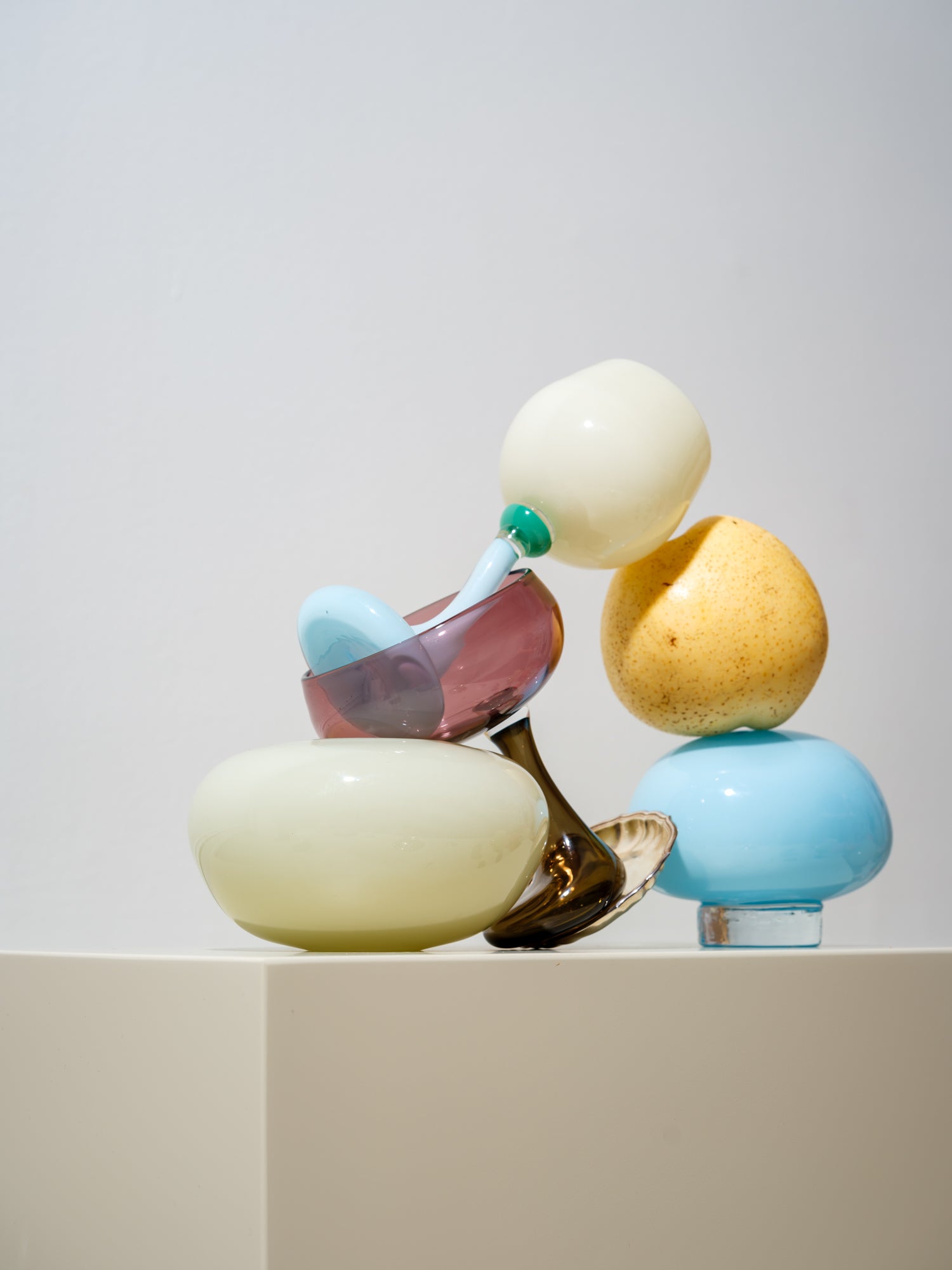
A Confectioner of Gravity: The Singular World of Helle Mardahl
Photo by Alastair Philip Wiper, courtesy Helle Mardahl Studio.
From the molten breath of Danish glassworks to the heavy permanence of Italian bronze and marble, we trace the evolution of Helle Mardahl's candy-coated universe.
The work of Helle Mardahl exists in a state of perpetual tension between the liquid and the solid, the fleeting and the final. In her studio, the visual language of childhood nostalgia, a sugary palette of milky roses, caramel ambers, and blueberry ice creams, is translated into forms that are at once deeply familiar and unsettlingly organic. The sugary gloss of her surfaces often belies the technical rigour required to produce them, a process that demands an absolute mastery over temperature, timing, and the physical limitations of the medium. For Mardahl, art is not merely a visual experience but a sensory society, a philosophy that dictates that objects should be felt, tasted, and lived with as much as they are seen.
Walking into her curated environments, one is reminded of the saturated, symmetrical dreamscapes of cinema, specifically the pastel-hued precision of Wes Anderson. However, Mardahl adds a distinctively Danish tactile sensibility to this aesthetic. Her objects do not sit passively on a plinth; they seem to pulse with a captured energy, as if the molten breath that gave them life is still circulating within their translucent walls. By blurring the lines between functional tableware, decorative lighting, and pure sculpture, Helle Mardahl has carved out a territory that is entirely her own, one where the sweetness of the form is balanced by the gravity of the material.
Origins
Born in 1976 in Denmark, Helle Mardahl was formed by a culture that prizes design as a fundamental pillar of daily life. Yet, her trajectory was never intended to follow the austere minimalism often associated with Scandinavian functionalism. Instead, she leaned into the expressive, the bulbous, and the dreamlike. Her education and early professional life led her to explore the intersections of glass, design, and sculpture, eventually founding her own practice where she could fully realise a vision of "magical realism."
The genesis of her signature style can be traced back to a specific moment of creative dissatisfaction. Mardahl recalls admiring a glass lamp but finding its form too rigid, its colours too muted. She questioned what would happen if that same object were rendered in the vibrant pinks, purples, and greens of a candy shop, shaped not by a geometric blueprint but by an organic, hand-blown pulse. This inquiry was the beginning of her "candy world," a creative breakthrough that redirected her practice toward the sensory-rich, hand-made objects that now define her oeuvre.

The practice
Mardahl’s broader oeuvre is a testament to the discipline of glassblowing, a craft as ancient as it is temperamental. Stationed at the legendary Holmegaard glassworks in Denmark, a facility established in 1825, her production relies on a team-based choreography. Each piece is mouth-blown, a process where molten glass, heated to over a thousand degrees, is gathered on a blowing iron and shaped in a matter of minutes. As Mardahl notes, the material has its own life, requiring a delicate balance of force and finesse. The glass must be worked while it is soft, its profile and wall thickness set before it begins to stiffen and eventually settles in the annealing oven to cool over many hours.
Beyond the glassworks, Mardahl’s practice has expanded into lighting and installation, notably with her exhibition titled The Sensory Society. Here, she invited viewers into a space inspired by the Grand Budapest Hotel, where pendant lamps in robin’s egg blue and Pepto-Bismol pink transformed architecture into a confectionery dream. Her work is now found in prestigious collections and reaches an international audience through collaborations that bridge the gap between high art and high design, always maintaining the "one-off" quality that comes from the touch of the hand.
I see glass as full of senses.
References and influences
The intellectual scaffolding of Mardahl’s work is built upon memory and cinematic aesthetic. She cites the saturated palettes of nostalgic films and the whimsical, often surreal quality of childhood treats as central influences. However, these are not merely superficial references; they are tools used to engage the senses. For Mardahl, a glass bowl is not just a vessel; it is a "Bonbonniere," a term that evokes the ritual of choosing a treat. She names her colors after edible delights, Milky Rose, Lavender, Caramel, to trigger a gustatory response in the viewer, a way to make the hard, cold surface of glass feel soft and inviting.
This sensory approach is also influenced by her collaborators, such as master glassblower Bjørn Friborg, whose technical expertise allows Mardahl to push the material to its limits. The goal is always to achieve a "softness" in a material that is inherently brittle. The organic, bulbous forms she creates are meant to be touched and held, breaking the traditional barrier of the "do not touch" gallery space. It is a pursuit of joy through form, a belief that the rituals of the everyday can be elevated by objects that possess a weird, luminous, and sugary soul.
In conversation
In her dialogues regarding her creative direction, Helle Mardahl emphasizes the importance of layers. She believes that the more senses an object can engage, the more fun and resonant the experience becomes. This "more, the merrier" philosophy is evident in the way she curates her collections, where a single lamp is rarely enough; instead, she creates entire worlds of color and light. She describes glass as an unpredictable material that requires a sense of calmness and intense concentration, a paradoxical state of being where one must be both in control and ready to embrace the magic of the fire.
Glass is such an unpredictable material, which makes it so utterly fascinating to work with.
The works with Edition Solenne
The collaboration with Edition Solenne represent a significant pivot in Helle Mardahl's career, as she translates her signature glass forms into the heavyweight mediums of bronze and marble for the first time. The centerpiece of this release is THE VASE MEGA (2025). Cast in polished bronze at the esteemed Fonderia Artistica Mariani in Italy, this work marks a transition from the ephemeral breath of glass to the enduring gravity of metal. While the form remains quintessentially Mardahl, bulbous and organic, the material brings a new sense of permanence. Bronze holds a level of detail that few other materials can, and in this polished state, it reflects its surroundings in a way that mimics the luminosity of her glass works, yet with a starkly different weight.
Standing 435 mm tall, THE VASE MEGA was created using the traditional lost-wax casting method. This involved creating a hollow wax replica of the artist's original form, which was then encased in a ceramic shell and fired. As the wax ran out, molten bronze was poured into the void, capturing every nuance of the artist's hand. Following the casting, the piece underwent rigorous chasing and assembly to ensure a continuous, seamless surface. The result is a work that feels like a prehistoric relic of a candy-coated future, an alloy that is intended to outlast the viewer. With an edition of only 14, it represents a rare bridge between Mardahl’s whimsical aesthetics and the classic traditions of Italian fine art foundry.

Continuing this exploration of materiality, THE BON BON MASSIVE (2025) shifts the focus to the subtractive art of stone carving. Crafted from Gallo Sienna and Botticino marble, this work was realized at the Massimo Galleni studio in Pietrasanta, a town famed for its connection to Michelangelo and the Apuan Alps. Unlike the additive process of glassblowing or the transformative process of casting, marble carving is a process of removal. The master carvers at Pietrasanta worked closely with Mardahl to translate her soft, rounded shapes into the hard, veined reality of natural stone. Each block was carefully selected for its color and grain, ensuring that no two pieces in the edition of 14 are exactly alike.
THE BON BON MASSIVE measures 486 mm in height, a vertical expression of Mardahl's candy-inspired forms rendered in a material that has been in the earth for millions of years. The process began with the "roughing out" of the block using point and tooth chisels, followed by the meticulous refinement of the surface with rasps and drills. The final polish reveals the depth of the marble, creating a surface that is as seductive to the touch as her glass pieces but possesses a cool, geologic stillness. It is a poetic contradiction: a "bon bon" made of ancient mountain, a playful gesture turned into a monumental object.

Finally, TRANSLUCENT DREAM (2025) returns the artist to her foundational medium of mouth-blown glass, though on a scale that pushes the boundaries of the craft. Created at Holmegaard in Denmark, this work is a one-of-a-kind sculptural object that captures the very essence of Mardahl's philosophy. It is described as a poetic expression, a moment between liquid and solid caught in time. The luminous surface and soft curves of the glass evoke a dreamlike fragility, yet its dimensions (600 mm in length) require immense physical strength and coordination from the glassblowers. It is a work that records the breath of its maker, frozen in a sugary, translucent state.
To produce TRANSLUCENT DREAM, the glass was gathered from the furnace at a working temperature of over a thousand degrees and shaped by hand and tool while still soft. Because glass settles free of internal stress only through a slow annealing process, the cooling of a piece this size is a critical, hours-long phase of production. The resulting object serves as the pure, rhythmic heartbeat of the Edition Solenne collection, anchoring the bronze and marble works back to the fluid, atmospheric origins of Mardahl's vision. In an edition of 14, it remains a testament to the enduring power of Danish glassmaking.

Closing
Helle Mardahl’s collaboration with Edition Solenne marks a maturing of her artistic narrative. By taking the fleeting, sugary forms of her glass practice and hardening them into bronze and marble, she has challenged the perceived lightness of her aesthetic. These works do not just exist in a candy world; they exist in the physical world of weight, history, and craftsmanship. Whether through the fire of the glass furnace in Denmark or the chisels of the marble carvers in Italy, Mardahl continues to prove that color and whimsy are not merely decorative, but are essential components of a deeply considered, sensory-rich life.


