
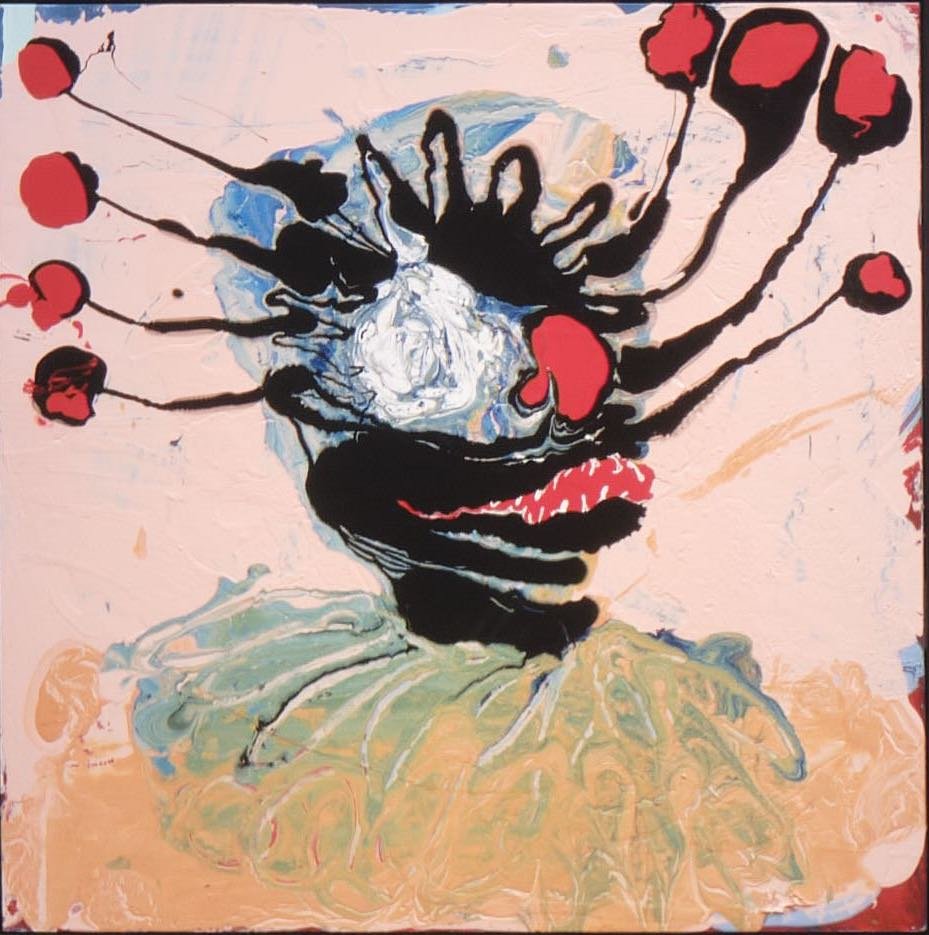
Tracing the high-speed evolution of a Danish powerhouse and his mastery of bronze patinas with Edition Solenne.
The studio of Frederik Næblerød in Sydhavnen, Copenhagen, is less a workspace and more a testament to the velocity of thought. Here, the air is thick with the scent of oil paint and the residue of material experiments, a physical manifestation of a practice that refuses to distinguish between the high-culture sanctity of the museum and the raw, unbuffered urgency of the street. Næblerød, born in 1988 in Frederiksberg, has emerged over the last decade as one of Denmark’s most vital contemporary voices, an artist whose work arrives as a series of energetic collisions between mythology, urban grit, and deep material resistance.
To encounter a work by Næblerød is to engage with a form of psychological weather. It is a practice built on the logic of the impulse; a belief that truth is found in the speed of the mark and the weight of the hand. Whether through his sprawling canvases or his dense, grotesque ceramic figures, Næblerød captures life at the point of transformation. Figures flare up and dissolve; faces emerge from murky transitions of paint or clay only to be half-buried again, as if the artist is catching the human condition in its most vulnerable and volatile states. There is a profound sense of survival in the work, a frank engagement with the fact that being alive is often a noisy and unpredictable ordeal.
The collaboration with Edition Solenne represents a specific chapter in this evolution: the translation of these ephemeral, high-speed impulses into the permanence of bronze. Working with historical foundries, Næblerød has managed to freeze the gestural violence and tenderness of his practice into an alloy that will outlast the hands that made it. These works are not merely smaller versions of his larger themes but are, instead, concentrated totems; compact site of emotional intensity that carry the full temperature of his studio into the domestic space.
Origins and the Geometry of the Street
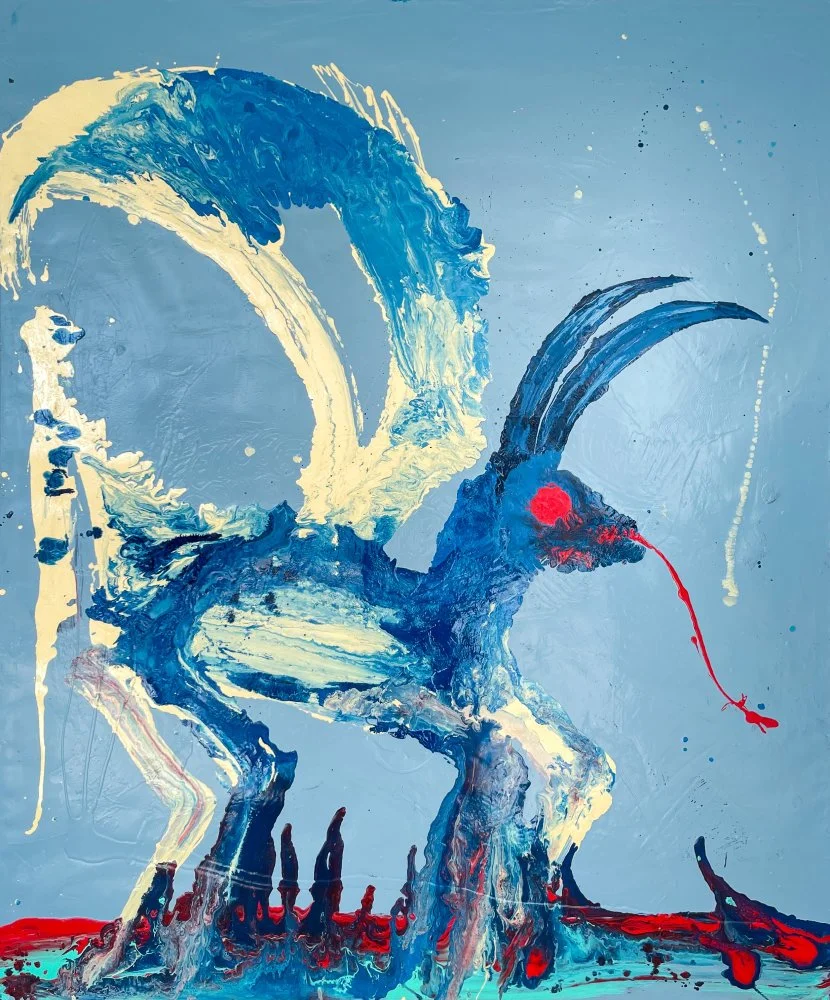
Frederik Næblerød’s formative years were defined by a certain kind of restlessness. Growing up in Frederiksberg, he found that the traditional academic structures of schooling were not his world. Instead, drawing became his primary method of being present, a way of decoding a reality that felt otherwise inaccessible. By the age of ten, Næblerød was introduced to the graffiti scene through his cousins. This was his first real school; a world of spontaneity, rhythm, and instinct where the city was not a backdrop but a participant in the work. The street taught him that no surface is neutral, that every wall carries weight, and that the audience is never passive.
This early immersion in graffiti gave Næblerød a unique relationship to scale and duration. Graffiti is, by nature, fast, risky, and temporary. It requires a total trust in one's own intuition, as there is often no time for second-guessing. While many artists move away from these roots as they enter the academy, Næblerød carried this urgency with him. When he was eventually accepted into the Royal Danish Academy of Fine Arts in Copenhagen, the shift was not a rejection of the street but a refinement of its energy. It was within the academy halls that he began to marry this raw instinct with a deep study of material and historical weight, eventually graduating with an MFA in 2018.
The academy years were life-transforming, providing the space to explore the limits of painting and ceramics alongside a cohort of peers who pushed the boundaries of expression. It was during this period that his practice began to caught the eye of the establishment, notably the gallerist Alice Folker. Yet, despite his professional ascent and his increasing presence in institutional contexts, the core of his impulse remains anchored in the ten-year-old boy following his cousins into the city night: the need to react, to mark, and to insist on personal presence against the void.
The Practice: Material Resistance and Grotesque Humor
Næblerød’s broader oeuvre is characterized by a refusal to stay within the lines, both literally and metaphorically. He is an artist of the 'bad painting' tradition, a term that refers not to a lack of skill but to a deliberate defiance of the classical canon of 'good taste.' Like Philip Guston before him, Næblerød avoids the conventions of high culture, opting instead for a naive figurative style that is rich with grotesque humor. His subjects are mythological creatures, fabulous animals, and figures wearing masks or hats; a carnivalesque parade that feels both ancient and contemporary. These characters entertain us, but they also carry a darker, more complex narrative of human vulnerability.
His material shifts are as frequent as his thematic ones. For years, Næblerød was known for his use of enamel paint, a choice driven by the need for speed. Enamel hardens quickly and cannot be reworked, forcing the artist to commit to every stroke. In these works, colors blend in murky, energetic transitions, creating compositions that feel as though they are vibrating. More recently, he has transitioned to oil paint, which offers a different kind of resistance. Oil allows for a slower maturation, a stacking of layers that adds tactility and depth to his figures, bringing them closer to the three-dimensional weight of his sculpture.

Ceramics play a vital role in this material dialogue. Since 2017, Næblerød has treated clay not as a medium for utility but as a site of physical combat. He often models his ceramic works deliberately thick, allowing the sheer weight of the material to dictate the expression. He embraces the unpredictability of the kiln, welcoming cracks and glaze irregularities as part of the work’s life. This same comfort with lack of control led him to bronze casting in 2023. Not content to simply hand over his models to a technician, Næblerød involved himself in the ritual of the foundry; the heat, the protective suits, and the liquid bronze flowing like lava. To him, the process is as vital as the object, a 'witch's cauldron' where intention meets the transformative power of fire.
References and Art-Historical Context
The lineage of Næblerød’s work is deeply rooted in Nordic expressionism and the CoBrA movement. He cites Asger Jorn and Pablo Picasso as top influences, alongside contemporary figures like Tal R and Katherine Bernhardt. Jorn’s influence is particularly palpable in Næblerød’s ability to 'structure chaos,' as the elder artist once described the goal of art. Like Jorn, Næblerød uses the mask as a recurring device. In his hands, the mask is not a disguise used to hide but a tool with which to test the limits of the face. It is a surface where protection and exposure occur simultaneously, a place where tenderness and threat can exist in a single expression.
Art is the ability to structure chaos, to give form to emotion.
There are echoes of Dubuffet’s Art Brut in the raw, unrefined energy of his figures, and of Georg Baselitz in the bodily logic of his compositions. However, Næblerød’s work feels distinctly of the now. It carries the pulse of an 'overheated time,' using expressionism not as a nostalgic retreat into the past but as a linguistic tool for the present. His work has been increasingly recognized by major Danish institutions, with his pieces held in the collection of Horsens Kunstmuseum and a massive solo exhibition, 'ALL WALKS OF LIFE,' slated for ARKEN Museum of Contemporary Art in 2025. This institutional embrace marks a significant chapter: the transition of an artist who once worked anonymously in the streets into a central figure of the national canon, all while maintaining his 'anti-institutional' soul.
In Conversation: The Intuition of the Artist
In an interview with Overstandard, Næblerød reflected on the necessity of friction. He believes the artist's role is to activate a space, to enter a room and allow something to shift in the viewer's perception. This friction is what creates a response; it prevents the work from being merely decorative. When asked about the recurring motif of birds in his work, he noted that they symbolize a fundamental drive: the desire to create without limits. This limitlessness is a double-edged sword; it provides the freedom to experiment wildly but also requires a total, sometimes exhausting, commitment to the work's internal logic.
The change of pace in 2022 was a turning point. Following his graduation, the demand for his work was intense, fueled by media appearances and a high-speed lifestyle. A friendship with fellow artist Jeppe Hein proved crucial, leading Næblerød to rethink his approach. He began to find peace and focus in his Sydhavnen studio, moving away from the 'wild rebel' persona projected by the media towards a more nuanced, deeply considered practice. This shift allowed him to reclaim his work from the sensationalism of the entertainment industry, focusing instead on the rigorous dialogue between himself and his materials.
For me, it is trusting my own intuition.
This trust in intuition is the thread that connects his graffiti, his large-scale paintings, and his intimate bronze works. It is a belief that the first impulse holds a certain purity that can be refined but should never be erased. In the studio, Næblerød continues to work fast, even on projects that might take months to complete. That foundational urgency ensures that the final work, no matter how heavy or permanent the material, still carries the spark of its origin.
The Works with Edition Solenne

The works released with Edition Solenne represent Næblerød’s mastery of the small scale and the complex chemistry of patination. Each piece was cast at the renowned Fonderia Artistica Mariani in Italy, an institution founded in 1952 that uses traditional lost-wax methods to capture the finest surface details. Through this collaboration, Næblerød’s expressive ceramic originals have been transformed into enduring bronze objects, each carrying the unique signature of the artist’s hand and the specific touch of the foundry’s patinators.
Small Totem (2021) is perhaps the most vibrant expression of this collaboration. Measuring 16 x 5 x 10 cm, this edition of 36 plus 6 Artist’s Proofs utilizes a spectrum of pink, blue, and green patinated bronze. The work functions as a personal story cast in metal; the hues are not mere decoration but emotional markers. The pinks and greens evoke a shifting internal landscape, inviting the viewer to define their own emotional journey through the work’s textured surface. The bronze preserves the 'material resistance' Næblerød is known for, holding onto the tool marks and finger depressions of the original model.
With Small Totem, Næblerød challenges the traditional gravity of bronze. Usually associated with the monochromatic or the dark, bronze here becomes a canvas for light. The interplay between the form and the vivid patina creates a sculpture that feels 'ever-evolving.' Because each piece is finished with heat and chemistry by hand, no two editions are identical. This uniqueness is central to Næblerød’s philosophy; even in a limited edition, the individual spirit of the object must be preserved. It is a work that demands a closer look, a physical engagement that reveals the depths of the artist's exploration of the grotesque and the beautiful.
Borderline Syndrome - Bronze Sculpture by Frederik Næblerød (2020) offers a different, more somber emotional register. Cast in blue and green patinated bronze and measuring 21 x 21 x 20 cm, this work is a journey through a psychological spectrum. The title itself points toward the instability and intensity of human emotion, a theme that Næblerød has navigated throughout his career. The deep blue and green hues pool in the crevices of the sculpture’s tortured, expressive form, creating a sense of depth that feels almost oceanic. It is a state of mind given physical weight.
The sculpture's form is quintessential Næblerød: a tangle of features and abstract shapes that seem to be on the verge of either coalescing into a face or collapsing into chaos. This edition, limited to 30 pieces, emphasizes the meticulous craftsmanship of the Mariani foundry. The rich patina accentuates the surface tension, making the work feel alive and 'everchanging.' It is an object that does not offer comfort; instead, it offers resonance, acting as a vessel for the viewer’s own experiences of transformation and vulnerability. In Borderline Syndrome, the bronze becomes a record of a psychic weather system that has been stilled but not silenced.
Finally, Tubilak (2020) stands as a testament to Næblerød’s engagement with myth and history. Measuring 19.5 x 7.5 x 6 cm, this dark brown patinated bronze sculpture draws on the Greenlandic concept of the Tupilak; a summoned spirit or vengeful object crafted from various materials. Næblerød’s version is a quintessential collector’s work, capturing the essence of his profound explorations into the 'other.' The dark brown patina gives the work an ancient, unearthed quality, as if it is a relic from a forgotten civilization that has been dragged into the contemporary light.
Tubilak was released in an edition of 36 and is now sold out from the gallery, a testament to its compelling blend of traditional craftsmanship and contemporary vision. The form is lean and focused, showcasing the artist’s dedication to the smallest details of texture and silhouette. Every individual patina in this edition adds to the object’s status as a 'standout piece of art,' emphasizing the role of the sculptor as a medium for narratives that are both personal and universal. Through Tubilak, Næblerød reminds us that art can be a protective charm, a warning, and a celebration all at once.
Closing: The Enduring Alloy
Frederik Næblerød remains an artist of the moment, yet his foray into bronze with Edition Solenne signals a desire to speak across time. His practice, once defined by the transience of the graffiti wall and the volatility of enamel paint, has found a new anchor. In the foundries of Italy and the quiet of his Sydhavnen studio, he continues to push material until it behaves like a mood, ensuring that the 'Næblerød universe' continues to expand and evolve.
As he looks toward his 2025 exhibition at ARKEN, it is clear that Næblerød’s work will continue to insist on life; on the messy, beautiful, and grotesque reality of being human. Whether through a massive museum installation or a small bronze totem, his voice remains consistent: urgent, intuitive, and deeply moved by the world it inhabits. In his hands, art is not a luxury but a necessity; a way of structuring the chaos of living into something we can hold, examine, and ultimately, share.


