
Through their ‘Vista’ series for Edition Solenne, Rotterdam duo Bienke Domenie and Sara Degenaar explore how a single silhouette is fundamentally rewritten by the alchemy of marble, bronze, and glass.
The work of Forever Studio exists at a sophisticated intersection where the precision of industrial assembly meets the fluid, unpredictable soul of material experimentation. Based in Rotterdam, the duo of Bienke Domenie and Sara Degenaar has cultivated a practice that prioritises the process of making as much as the finished object. Their studio is a site of constant inquiry, a place where resin, aluminium, and polished steel are pushed beyond their traditional utility to become something atmospheric and emotionally resonant. In their collaboration with Edition Solenne, this inquiry has reached a new level of formal purity. By isolating a single architectural silhouette and casting it into three of the most historically significant materials in the canon of art, bronze, marble, and glass, they have created a profound meditation on the weight of matter and the character of light.
The resulting 'Vista' series is not merely a collection of objects but a comparative study in perception. To see the same profile rendered in the deep, geological weight of Rosso Verano marble, the warm, matte gravity of patinated bronze, and the ethereal, fleeting transparency of mouth-blown glass is to understand how material choices dictate our emotional response to space. Domenie and Degenaar do not simply design furniture or lighting; they create 'spatial design' that functions as a bridge between the autonomous art object and the functional interior. Their partnership, forged in the heat of a metalworking workshop and refined through years of collaborative research, has become one of the most compelling voices in contemporary collectible design, challenging our expectations of what an everyday object can hold.
Origins and the Rotterdam School
The partnership of Forever Studio began at the Willem de Kooning Academy in Rotterdam, where both Bienke Domenie and Sara Degenaar were enrolled in the Lifestyle Transformation Design programme. This specific pedagogical background is crucial to understanding their work; it is a discipline that looks beyond the surface of product design to examine how objects transform our environments and our habits. However, the true catalyst for their collaboration was found in the physical rigour of the metal workshop. It was here, amidst the sparks and the heavy machinery of the academy’s labs, that the two founders first began to synchronise their creative rhythms. Graduating in 2015, they formed Forever Studio almost immediately, carrying with them a fascination for the ‘experimental phase’ of production.
Rotterdam, a city defined by its industrial port and its resilient, avant-garde architecture, provides an apt backdrop for their work. The studio’s early output was characterised by a visceral engagement with industrial processes. They worked extensively with resin casting, exploring how liquid polymers could be manipulated with bespoke color-blending techniques to create motifs that felt organic rather than synthetic. Their 'Another Motif' room divider and various 'Flat Light' sculptures are testament to this period, where they acted as much like chemists as designers. By maintaining their production within the sphere of local artisans and industry, they ensured that every piece retained a 'one-of-a-kind' quality, even when commissioned for commercial spaces or fashion brands like Wandler and Wandler. This commitment to the 'autonomous' side of design has allowed them to move seamlessly between the gallery world and the high-end retail environment.
The Practice: Research and Atmosphere
Central to the Forever Studio ethos is the belief that an object is a record of its own making. Whether they are folding 1-millimeter mirrored sheets of aluminum for their ‘folded sculptures’ or polishing stainless steel for the ‘Sham Mirror’, the physical actions of the hand and the tool are left palpable in the final form. Their work often highlights the beauty of assembly; for instance, their 'Spring' console, produced for the 'Domestic Pleasures' exhibition at Tableau, utilizes visible bolt assemblies that become decorative elements in their own right. This transparency of construction is a hallmark of their broader oeuvre, suggesting that there is no need to hide the logic of a piece.
The studio works at the intersection of autonomous design, commercial design and spatial design, with a strong focus on material experimentation.
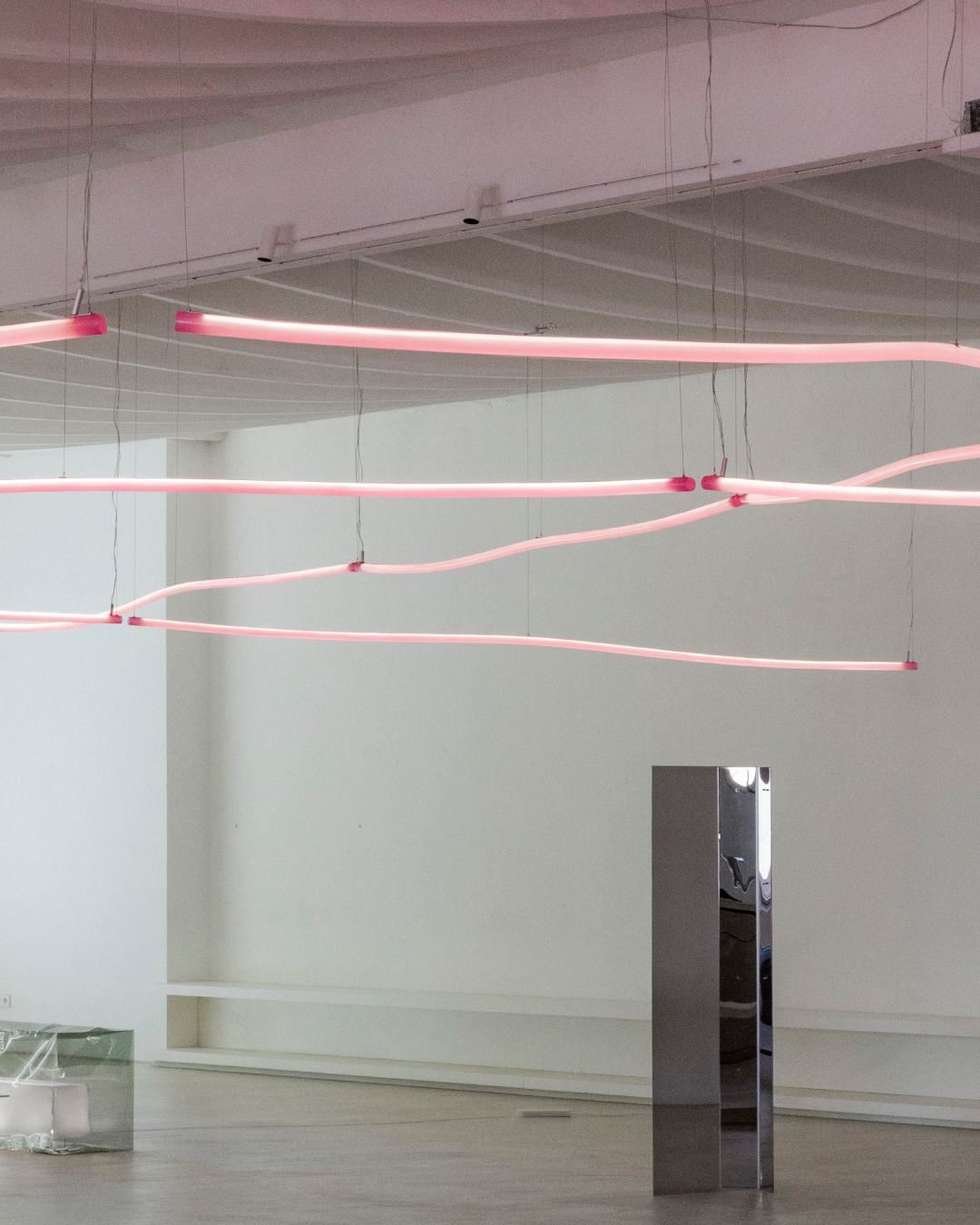
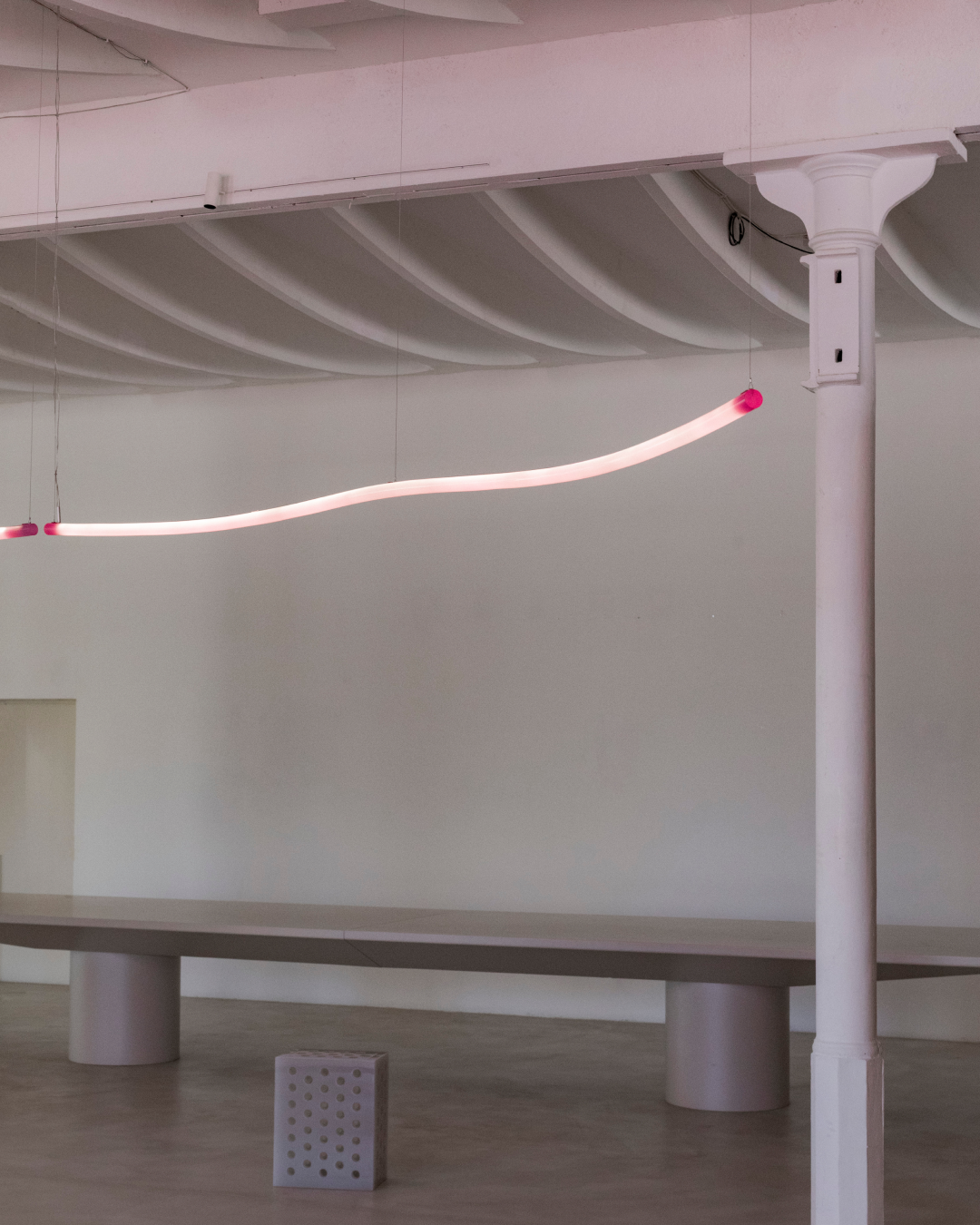
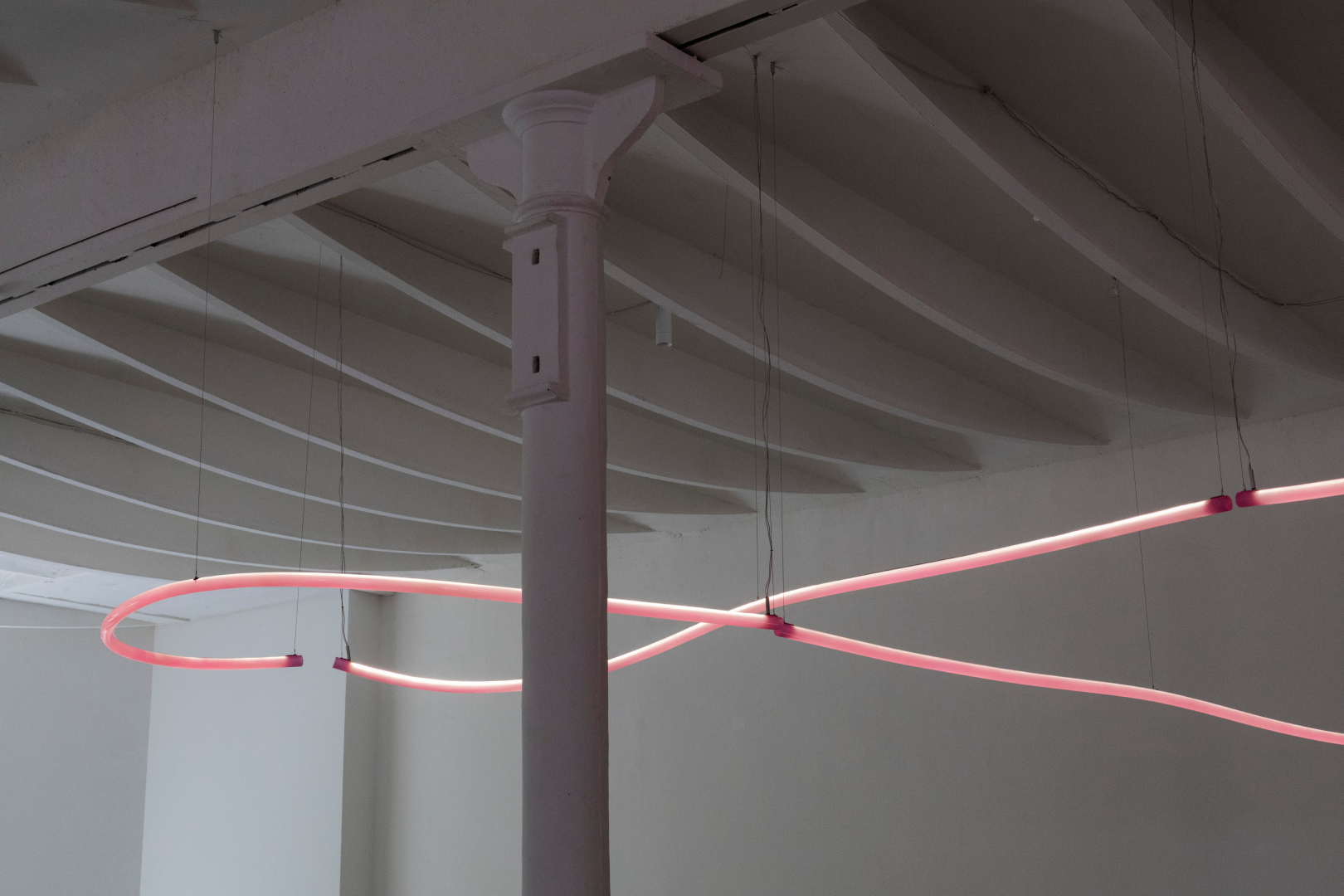
Their practice is also deeply concerned with 'interior atmospheres.' This is perhaps best exemplified in their 'Shea Collection' and 'Beam Light' projects. The 'Beam Light', a resin sculpture that can extend from floor to ceiling, treats light as a structural material, using it to emphasize the verticality of a room. Similarly, the ‘Shea’ pieces combine resin and anodized aluminium so seamlessly that the transition between metal and polymer appears alchemical. It is this ability to marry disparate materials without visible joins that has caught the attention of curators worldwide, leading to representation by Vasto Gallery in Barcelona and features in publications such as Harper’s Bazaar. They are not interested in standardized product lines; instead, they focus on the 'transformation of matter into spatial, collectible and emotionally charged forms.'
References and Influences
Domenie and Degenaar often draw inspiration from the tension between the natural world and the manufactured one. In their 'Patos' series, developed for Project Materia 2026, the duo referenced the wide, spreading canopy of the Patos tree to inform the silhouette of their stools. This translation of organic logic into the language of 'Matek' (a recycled material blend) showcases their ability to abstract nature into something functionally robust but conceptually deep. They are also influenced by the history of sculpture; their frequent trips to Pietrasanta, Italy, to work with master carvers and foundries suggest a deep respect for the art-historical weight of their chosen media.
The influence of contemporary photography and installations also plays a role in their conceptual development. Their collaboration with the Ritsch Sisters on the 'Sitting With' bench is a prime example. This see-saw-like object was designed to capture the 'balance between personal expression and shared experience,' reflecting on themes of touch, presence, and identity. By creating objects that require another person to function, or that change appearance based on the viewer’s perspective, Forever Studio moves its furniture into the realm of social sculpture. They cite a desire to find 'surprising combinations between unique and commercial design,' looking for 'unexpected connections between art, design and everyday aesthetics' that keep their work from ever feeling static or purely decorative.
In Conversation with Matter
In interviews, the duo emphasizes that their research is never truly finished. Each project is a stepping stone to the next material discovery. When discussing the 'Vista' series, they describe it as a 'study of a single form held across three materials.' This focus on a single form allows them to eliminate the distraction of varied geometry and focus entirely on the 'reading' of the material. They often speak about how a form can feel 'weightless in glass' but 'grounded in bronze,' a shift that occurs not in the sketch but in the hand of the artisan.
Their collaboration with Edition Solenne and Tableau for 'Project Materia' was a turning point in this research. It required them to engage with traditional masters of their craft, from the glassblowers at Holmegaard in Denmark to the carvers in the Apuan Alps. This dialogue between the studio’s contemporary, concept-based approach and the centuries-old traditions of the craftsmen in Pietrasanta and beyond created a productive friction. As they noted during the preparation for the series, the process was about 'continually searching for unexpected connections,' finding that even the most 'industrial' designers have much to learn from the way a master carver reads the veining of a marble block before the first cut is made.
Patos comes from the name of the tree we used as a reference for the pattern, and means 'wide' as well.
The Works with Edition Solenne
The 'VISTA MARBLE' (2025) represents the most historically grounded iteration of this series. Hand-carved from Rosso Verano marble at the studio of Massimo Galleni in Pietrasanta, Italy, this work is an exercise in subtraction. Where the studio’s work in resin involves building up layers, the marble work is about removal. Each block is selected from the quarries above Pietrasanta, assessed for its unique grain and deep red ground. Because marble is a geological record millions of years in the making, no two editions of VISTA MARBLE are ever identical; the carver must navigate the specific density and drifting veins of the individual block to find the form hidden within.
The sculpture is worked by hand using traditional tools: the point and tooth chisel for roughing out the mass, followed by the rasp, riffler, and drill for refining the profile. The final finish is a honed surface that reveals the incredible depth of the Rosso Verano stone. In this material, Forever Studio’s architectural silhouette takes on a 'storied' quality. It is an object that feels permanent, a heavy and grounded presence that carries the 'colour and grain of the quarry into a clean, contemporary form.' While the outline is minimal and modern, the material provides a rich, complex texture that anchors any room it occupies.
The 14 editions (plus artist’s proofs) of VISTA MARBLE serve as a testament to the Versilia tradition of carving. By placing a contemporary Rotterdam design in the hands of Italian masters who have been working since 1995, Edition Solenne has facilitated a work that is both an avant-garde object and a traditional sculpture. It is the most earthbound and geological of the triplet, a piece that suggests that the modern can still find a home in the ancient bones of the earth. The engraved signature on each piece acts as a modern mark on a material that has existed for eons, creating a timeline that spans from the prehistoric to the present.
In contrast, the 'VISTA BRONZE' (2025) offers a different kind of permanence. Cast at the Fonderia Artistica Mariani in Italy, a foundry with an illustrious history dating back to 1952, this work uses the traditional lost-wax method to capture every nuance of the artist’s original model. The process begins with a hollow wax replica being refined by hand until it is perfect. This is then encased in ceramic, fired, and replaced by molten bronze. The resulting object holds a level of detail and a 'weighted' presence that only an alloy of this nature can provide. It is a physical record of the hand that made it, now hardened into a form that is designed to outlast its owners.
The finish of VISTA BRONZE is a study in heat and chemistry. Each piece is patinated by hand, a process that colors the metal and creates a unique surface for every edition. Unlike the marble, which has a natural grain, the bronze’s character is determined by the specific reaction of the metal to the artisan's chemicals. This creates a low, matte reflection that catches the light differently than the glass or the stone versions. It is an object that 'settles into a room and holds its place,' standing 480 mm tall with a quiet, undeniable gravity. It represents the 'warm and quietly weighted' side of Forever Studio's practice, where metal is treated not as an industrial component but as a skin that breathes.
The bronze version highlights how the material itself decides the perception of a form. While the silhouette is identical to its siblings, in bronze it feels 'more grounded,' its surfaces seemingly absorbing the environment rather than reflecting it. The seams are chased away by hand so the metal reads as a single, continuous surface, emphasizing the sculptural integrity of the work. For collector’s of Forever Studio, VISTA BRONZE is the quintessential example of their ability to take a clean, architectural profile and give it a 'solid, warm' soul that feels both industrial and artisanal.
Finally, the 'VISTA GLASS' (2025) completes the trilogy by turning form into air. Blown by hand at Holmegaard in Denmark, one of Scandinavia’s most storied glassworks founded in 1825, this piece is the most ephemeral reading of the Vista profile. Whereas the marble and bronze take weeks or months to carve and cast, the glass piece is formed in a matter of minutes as molten glass, heated to over a thousand degrees, is gathered on a blowing iron and shaped by the breath and timing of the craftsman. This 'fast' medium records the movement of the maker in a way that the 'slow' mediums of stone and metal cannot, resulting in a work that is as much about energy as it is about matter.
The VISTA GLASS functions as a vessel for light. Standing at 550 mm, it is slightly larger in its vertical presence than the bronze, catching reflections and throwing soft color throughout a space. Placed near a window, the piece 'reads as one object,' but moved into shadow, it 'reads as another.' It is a fugitive work that shifts as the viewer moves around it, making the architectural profile almost disappear into its surroundings. No two pieces cool exactly alike in the annealing oven, meaning that each of the 14 editions carries a unique internal stress and clarity, a signature of the mouth-blown process.
This glass iteration is the most 'atmospheric' of the trio. It captures the 'lightness' that Domenie and Degenaar often strive for in their resin works but achieves it with a material that has a much higher degree of refractive brilliance. By choosing Holmegaard, a name synonymous with Danish design tradition, Forever Studio has bridged their experimental Rotterdam aesthetic with a refined, northern European clarity. The VISTA GLASS does not anchor a room so much as it lightens it, serving as a reminder that even the most rigid architectural forms are ultimately subject to the conditions of the light in which they are seen.
A Lasting Coda
The Vista series is a landmark for Forever Studio, a culmination of a decade spent investigating how materials speak. Through the support of Edition Solenne, Bienke Domenie and Sara Degenaar have been able to step away from the immediate concerns of resin casting to engage with the 'permanent' materials of the art world. Yet, they have done so without losing the experimental spirit that defined their early years in the metal workshops of Rotterdam. These works are not merely high-end furniture; they are 'emotionally charged forms' that challenge the collector to look closer at the grain of a stone, the patina of a metal, and the clarity of a glass wall.
As they move forward with new projects for Project Materia and various international galleries, the lessons of Vista remain clear: form is only half of the story. The other half is found in the physical reality of the matter from which that form is pulled. Whether working with the master carvers of Italy or the glassblowers of Denmark, Forever Studio continues to find the 'surprising combinations' that make contemporary design so vital. They have proven that in the hands of the right artists, even the most traditional materials can be made to feel entirely new, speaking a language of atmosphere, weight, and light that is uniquely their own.


