
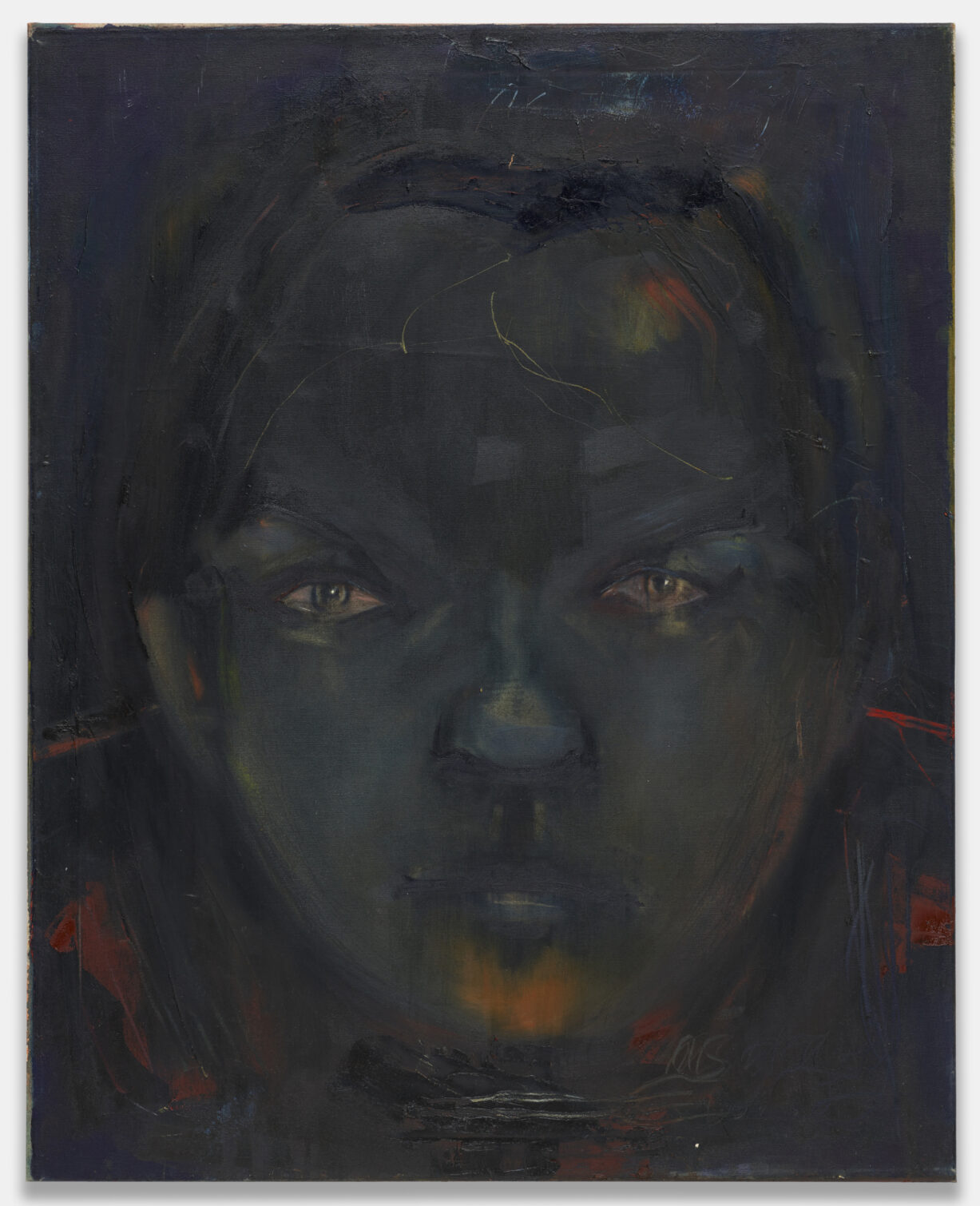
Cathrine Raben Davidsen: The Alchemy of Transformation
Image courtesy the artist.
Across painting, ceramics, and now limited editions in bronze, marble, and glass, the Copenhagen-based artist explores the ancestral rhythms of making and the metamorphosis of the human form.
When entering the Copenhagen studio of Cathrine Raben Davidsen, one is immediately struck by a sense of temporal collapse. Under a colonnade in the heart of the city, her workspace functions as a modern-day wunderkammer where flat files of contemporary prints sit alongside piles of art books, medieval texts, and classical research notes. The air is thick with the scent of oil paint and the quiet energy of an artist who operates as much like a researcher or a theologian as a traditional painter. For Raben Davidsen, the act of creation is never a solitary gesture of the present; it is a conversation with the long shadow of history, mythology, and the material intelligence of the past.
Her practice is famously multidisciplinary, a fluid movement between the light touch of printmaking and the heavy materiality of ceramics, the atmospheric depths of oil painting and the exacting demands of stage design. Yet, regardless of the medium, a consistent thread runs through the work: a preoccupation with the boundary between the visible and the invisible. Whether she is rendering a delicate face on a ceramic cup or exploring the chemical clashing of materials on a lithographic stone, she seeks the moment of transformation where raw matter becomes a carrier for human presence and memory.
In her collaboration with Edition Solenne, Raben Davidsen has extended this inquiry into the realms of cast bronze, hand-carved marble, and mouth-blown glass. These objects are not merely functional vessels or decorative furniture; they are continuations of her lifelong study of the figure and the vessel as twin containers for the soul. They represent a deepening of her commitment to craftsmanship, realized through partnerships with some of Europe’s most prestigious ateliers, from the bronze foundries of Pietrasanta to the glassworks of Holmegaard.
Origins and the Classical Foundation
Born in Copenhagen in 1972, Cathrine Raben Davidsen’s path to the upper echelons of Danish contemporary art was marked by a rigorous, almost polymathic education. Before her formal training at the Royal Danish Academy of Fine Arts, her intellectual curiosity led her through a year of theology and a period of studying philosophy in London. This academic grounding in the systems of belief and the structures of human thought remains a skeletal framework for her visual work, providing a weight that balances her technical virtuosity.
However, it was Florence that truly forged her artistic identity. Studying in the early 1990s under teachers Rose Shakinovsky and Claire Gavronsky, she was immersed in the cradle of the Renaissance. In a studio set within a vineyard, she first encountered the printing press, becoming obsessed with the rapid, monotype process that captures a single, unrepeatable instance. Florence offered her a world that felt frozen in the fifteenth century, a monument to a time when art was inextricably linked to the study of nature, anatomy, and the divine. She spent untold hours painting the figure from life, mastering the classical skills of perspective, light, and shadow that many of her contemporaries were then moving away from.

Returning to Copenhagen, she found herself momentarily at odds with the prevailing conceptual trends of the Royal Danish Academy. Feeling that her traditional approach was considered old-fashioned, she transitioned to the School of Walls and Space (the School of Conceptual and Contextual Practices). This tension between her classical technical ability and the conceptual demands of contemporary art is exactly where her work now lives. She is an artist who can draw with the precision of a master but chooses to invite accident, spillages, and the 'rare magic of chemically clashing materials' into her process. This dance between control and loss of control has become her signature.
The Practice: A Laboratory of Materials
Raben Davidsen describes her process as that of an 'eternal student.' For her, the studio is a laboratory where she acquires a body of knowledge through intense research, only to deliberately lay it aside during the physical act of making. Her paintings often emerge from a chaotic environment where she might use coffee or cola to mix her inks, overriding her highly organized research notes and 'mind maps' with the visceral, messy reality of the medium. This allows her to reach what she calls the borderland between figuration and abstraction, a space where the work possesses both lightness and depth.
It’s important for me to keep evolving by reading and researching, but also by physically experimenting with materials. As an artist, I’m an eternal student.
Her ceramic work, notably her extensive collaboration with Royal Copenhagen, demonstrates this same interest in the intersection of history and material. In her Totem series, she explored the vessel as a figurative object, creating lidded stoneware urns and oxblood-glazed jugs that seem like excavated artifacts from a lost civilization. These works often feature faces that seem to emerge through the glaze, ghosts of the classical training she received in Florence, reimagined through the unpredictable fire of the kiln. In every medium, she is looking for the 'metamorphosis,' a concept she traces back to Ovid and the rediscovery of antiquity during the Renaissance.
References and Influences
The lineage of Raben Davidsen’s work is populated by the titans of art history. She cites the printmaking of Rembrandt van Rijn, Francisco Goya, Odilon Redon, and Edvard Munch as foundational to her understanding of how a surface can hold emotional weight. From Rembrandt, she learned the power of the etched line; from Munch, the ability to let a material echo a psychological state. She is deeply invested in the works of Sandro Botticelli, particularly 'La Primavera,' which she returned to Florence to study specifically with support from the Danish Arts Foundation. She views Botticelli as an outsider who navigated the complex symbolism of his time to create something eternally resonant.
Her influences are not limited to the visual arts. She draws heavily on mythological material, works of fiction, and the current social and philosophical thinking of our time. This rich tapestey of references allows her to explore the 'essential traits of human nature' without becoming mired in any single historical moment. She treats history as a toolbox, using ancient techniques to address existential questions of life, death, and transformation that remain stubbornly relevant today.
In Conversation: The Joy of Play
In conversation, Raben Davidsen emphasizes that despite the seriousness of her themes, the act of making is essentially about play. It is a 'laboratory study' where the goal is to discover something unexpected. She speaks of the 'freedom in the loss of control,' particularly in printmaking where the image is reversed and the artist often works 'blind' regarding the final color chemistry. This willingness to be surprised is what prevents her work from becoming a mere academic exercise in classical form.
For me, making art is about playing. It’s not always easy play. My process is like a laboratory study, where I get to experiment.
This philosophy of play extends to her move into larger-scale sculptures and furniture with Edition Solenne. She approaches a block of marble or a crucible of molten glass with the same experimental spirit she brings to a monotype. The goal is always to find the 'interplay of invisible and visible,' to create an object that feels as though it is holding a presence rather than just occupying space.
The Works with Edition Solenne
The collaboration between Cathrine Raben Davidsen and Edition Solenne represents a significant milestone in her career, translating her characteristic atmospheric style into the durable languages of bronze, stone and glass. Each piece is a limited edition of 14, plus artist’s proofs, ensuring that the hand-finished quality of her studio practice are maintained across these more enduring materials.

The FIGURINE VASE (2025) is perhaps the most direct translation of her figurative interests into a three-dimensional object. Cast in the prestigious Fonderia Artistica Mariani in Italy, the work utilizes the traditional lost-wax method, a process where the artist's original form is captured in a ceramic shell, then destroyed by molten metal. Measuring 380 x 175 x 175 mm, the vessel reads as both an object and a figure, its silhouette suggesting a human presence that has been quieted and contained. It is a vessel that behaves like a portrait, self-contained and heavy with gravity.
The defining characteristic of this work is its Dark Blue patina. Bronze holds a detail and depth that few other materials can afford, and here, the surface is colored with heat and chemistry to create a finish that shifts from near-black in shadow to a cooler, painterly blue in the light. This choice of color is not accidental; it gives the bronze the depth of a painted ground, reminiscent of the atmospheric backgrounds in her oil paintings. Each edition is patinated by hand, meaning the marks of the making are preserved in the metal, creating a physical record of the hand that will outlast the viewer.
To touch the FIGURINE VASE is to feel the weight of history. The lost-wax process is an ancient craft, used for millennia to commemorate gods and heroes. By applying this technique to a vessel that 'holds presence rather than flowers,' Raben Davidsen elevates a functional form into the realm of the existential. It is an object that demands silence and contemplation, a permanent anchor in a world of transient digital images.
The ORBIS TABLE (2025) takes Raben Davidsen's inquiry into the earth itself. Carved from Botticino Marble by the master carvers at Massimo Galleni’s studio in Pietrasanta, the table is a testament to the art of removal. Measuring 350 x 340 x 340 mm, it is a compact, dense object that carries the millions of years of history embedded in the stone. Unlike painting, where layers are added, the ORBIS TABLE is created by subtracting mass, a process of refinement that requires the carver to read the specific veining and density of the individual block.
The choice of Botticino Marble, with its warm, creamy tones and subtle grain, allows the form to speak without the distraction of heavy veining. The piece debuted at 3daysofdesign 2025 in Copenhagen and was subsequently shown at CHART 2025, marking its place at the intersection of fine art and collectible design. The surface is worked from coarse chiseling to a fine, honed finish, revealing a depth that can only be achieved through hand-carving with rasp, riffler, and drill. It is an object that feels as though it has always existed, discovered within the block rather than designed.
The ORBIS TABLE serves as a structural counterpoint to her more fluid paintings. Yet, in its rounded forms and the way it occupies the room, it retains the organic, almost bodily quality found in all her work. It is a piece of furniture that functions as a sculpture, a solid manifestation of the artist's fascination with the 'chemical-geological aesthetic' she often explores on paper and stone in her printmaking process.
Finally, the ALCHEMIST VASE (2025) explores the most literal form of transformation: the turning of sand and heat into clear, mouth-blown glass. Produced at the storied Holmegaard glassworks in Denmark, this work (260 x 200 x 200 mm) records the breath and timing of the glassblower. Glass is a material made in minutes but cooled for hours; it is a frozen movement. The ALCHEMIST VASE carries the small irregularities of its making, the faint bubbles and movements that are the hallmarks of craft rather than industrial production.
The title of the work is a reference to the alchemical process of turning raw, base matter into something precious. In Raben Davidsen's hands, the glass becomes a medium for light. The vessel does not just contain its contents; it captures the light passing through it, pooling it inside and changing its quality across the day. It is an object that appears both permanent and fragile, a duality that is central to her exploration of the human condition.
For the collector, the ALCHEMIST VASE represents the lightest touch of Raben Davidsen's Edition Solenne series. It is a work that feels airy and ethereal compared to the bronze and marble, yet it carries the same weight of intent. It is a culmination of her interest in how materials can be altered by fire and human intervention into objects that seem to hold an internal life of their own.
Closing: The Eternal Student's Return
Through these diverse materials, Cathrine Raben Davidsen continues to demonstrate why she has remained a distinct and unwavering voice in Danish art for over three decades. Her work for Edition Solenne is not a departure from her practice but a solidification of it. By working with the foundries and stone workshops of Italy and Denmark, she has ensured that her preoccupation with the figure, the vessel, and the transformative power of art is translated into objects that will endure.
In the end, Raben Davidsen remains the 'eternal student,' always looking back to the Renaissance or the myths of antiquity to find new ways to understand the present. Whether through the cool surface of a Dark Blue bronze vase or the solid mass of a marble table, she invites us to look closer, to find the presence within the object, and to appreciate the rare magic that happens when a master of craft lets go of control.


