

By translating frictionless digital volumes into the heavy permanence of bronze, marble, and glass, Andrés Reisinger challenges the perceived boundaries between the screen and the physical world.
For Andrés Reisinger, the digital realm is not a secondary space or a mere staging ground for the real; it is a primary site of discovery. Based between Madrid and Barcelona, the Argentinian artist has spent over a decade dismantling the hierarchy that places physical objects above digital ones. His practice moves with a fluid, almost liquid ease between 3D renders that capture the global imagination and tactile sculptures that demand to be felt. In Reisinger’s hands, a pixel is as much a material as a piece of Carrara marble or a gather of molten glass. His work explores the liminal space where our digital experiences, those hours spent navigating screens and glowing interfaces, intersect with our biological need for texture, weight, and light.
The artist often speaks of his work as an engagement with 'experiences' rather than mere products. Whether it is a viral digital installation draped over the architecture of a global city or a singular chair that seems to be made of thousands of pink petals, the core of the work remains a study in human perception. Reisinger’s arrival at Edition Solenne represents a significant milestone in this career-long translation. Here, three specific forms, originally conceived in the frictionless vacuum of a digital workspace, have been tethered to the earth through the expertise of European master artisans. In a world that often demands we choose between the digital and the physical, Reisinger argues for a third path: a future of coexistence.
Origins and the Digital Ethos
Born in 1990 in Buenos Aires, Andrés Reisinger grew up in a culture where constraints were often met with imaginative bypasses. His early attraction to the digital realm was a response to its lack of boundaries. For a creative spirit who described himself as extremely disciplined and drawn to all that is new, the computer provided a field for experimentation that was not limited by the cost of materials or the laws of physics. However, Reisinger did not view this as an escape from reality; instead, he viewed it as a way to expand it. His education and early professional life saw him mastering 3D rendering tools not just for visualization, but as a medium of pure artistic expression.
The transition from Buenos Aires to Spain consolidated his vision. Operating from his studios in Madrid and Barcelona, he began to develop a language that blurred the lines between interior design, sculpture, and digital art. Reisinger’s work first touched the global mainstream through pieces like the Hortensia chair, which started as a digital render but became so demanded by the public that he was forced to find a way to manifest it physically. This 'demand before supply' model has since become a hallmark of his practice, a way of testing the collective desire of a global audience before committing resources to the material world. It is a philosophy that views the digital as a laboratory where the ideal outcome can be achieved and refined before it ever touches a workshop floor.
The practice: Between Take Overs and Monuments
Reisinger's broader oeuvre is characterized by a specific, dreamy aesthetic, often punctuated by shades of pink, a color he describes as universal because 'all human beings are pink inside.' This intimacy is reflected in his 'Take Over' series, where digital drapery and soft forms are superimposed onto the streetscapes of cities like Paris, Dubai, and New York. These works, which often go viral on social media, create a moment of pause in the urban churn, suggesting a world that is softer and more accommodating than the one we typically inhabit. While these digital gestures are ephemeral, they have recently begun to find physical footprints in installations at Art Basel Miami and Riyadh’s Al-Balad festival.
His exhibition history is a testament to the blurring of high art and design. From showing 12 Chairs for Meditation with Nina Yashar at Nilufar Gallery in Milan to curating the permanent collection at the Vitra Design Museum, Reisinger has moved beyond the 'digital artist' label. His works are now held in significant collections and shown in institutions such as the Denver Art Museum. This institutional recognition validates his core thesis: that the medium (digital or physical) is less important than the emotional and conceptual weight of the vision. He refuses to see the digital and physical as antagonists, instead treating them as complementary halves of a singular reality.
I foresee a future where the digital world and the physical one are able to coexist, inform, and benefit each other.
References and Art-Historical Context
To place Reisinger in an art-historical context is to look at the lineage of artists who used the newest tools of their time to explore enduring human concerns. Just as the Impressionists used the invention of portable paint tubes to move outdoors and capture light, or how the Minimalists used industrial manufacturing to strip form to its essence, Reisinger uses 3D software to explore the 'unbound' form. His work shares the soft, biomorphic language of artists like Jean Arp or Henry Moore, but his forms are informed by a digital softness that handles light with a mathematical precision those earlier masters could only intuit.
His choice of pink is not merely a stylistic quirk but an ontological claim. By focusing on a color that represents the internal reality of the body, he bridges the gap between the 'cold' technology of the computer and the 'warm' reality of human biology. This interest in the sensory is what separates him from many other digital creators. Reisinger is obsessed with how a material feels to the eye, the way light scatters through a digital shader is a direct precursor to how he expects it to scatter through a block of Bianco Statuario marble. He draws from the tradition of the 'Gesamtkunstwerk', or total work of art, where every element, from the sound of a digital environment to the specific patina on a bronze, is carefully curated to evoke a specific mood.

In conversation: Shaping the Landscape
In his discussions regarding the role of technology, Reisinger is notably optimistic. He pushes back against the notion that digital art is somehow 'less human' than traditional crafts. For him, the computer is a tool, no different from a painter's brush or a sculptor's chisel. He argues that we 'shape and mold' the digital landscape through human ingenuity. In an era where many fear the replacement of the human hand by Artificial Intelligence, Reisinger sees an opportunity for the 'augmentation' of creativity. He uses AI to test public desire and to explore forms that might have been unfeasible to imagine using older methods.
When asked about the future of physical exhibitions in an age of augmented reality, Reisinger is steadfast in his belief in the tangible. He notes that humans 'crave the tangible, as they should.' His goal is not to replace the physical experience with a digital one but to enrich both. He speaks of an 'infinite hue of grays' in human experience, rejecting the binary of choosing one realm over the other. This philosophy is precisely what led him to the workshops of Europe to produce his collection with Edition Solenne. These works are the embodiment of that synergy, where the 'impossible' forms of the digital world are realized through the centuries-old techniques of master casters, carvers, and glassblowers.
Like a painter uses their brush to create art, we shape and mold the digital landscape.
The works with Edition Solenne
The first work in the collection, SÁBADO (2025), is a profound study in the weight of time and the translation of light. Named after the Spanish word for Saturday, the piece captures the slow, aimless mood of a day that owes nothing to productivity. Originally rendered as a soft, weightless volume in digital space, Reisinger has chosen to manifest this form in Orange Yellow patinated bronze. The choice of material is deliberate; bronze is a substance that implies a permanence far beyond the lifespan of any digital file. Produced at Fonderia Artistica Mariani in Italy, a foundry that has operated since 1952, the work undergoes a traditional lost-wax casting process. This method, involving the destruction of a wax original to make way for molten metal, mirrors Reisinger’s own process of 'solidifying' his digital dreams.
SÁBADO stands at 477 x 414 x 373 mm, a scale that invites both observation and touch. The orange-yellow patina is applied by hand using heat and chemistry, ensuring that each of the 14 editions possesses its own unique chromatic vibration. While the digital render of SÁBADO is endless and perfect, the bronze version is particular and heavy. This translation is the real subject of the work: the moment a frictionless image gains gravity. The patina holds the glow of a remembered sunset, turning the object into a record of a specific mood. In the transition from render to bronze, the work loses its digital perfection but gains a physical soul, one that will oxidize and change as it is lived with and handled over decades.
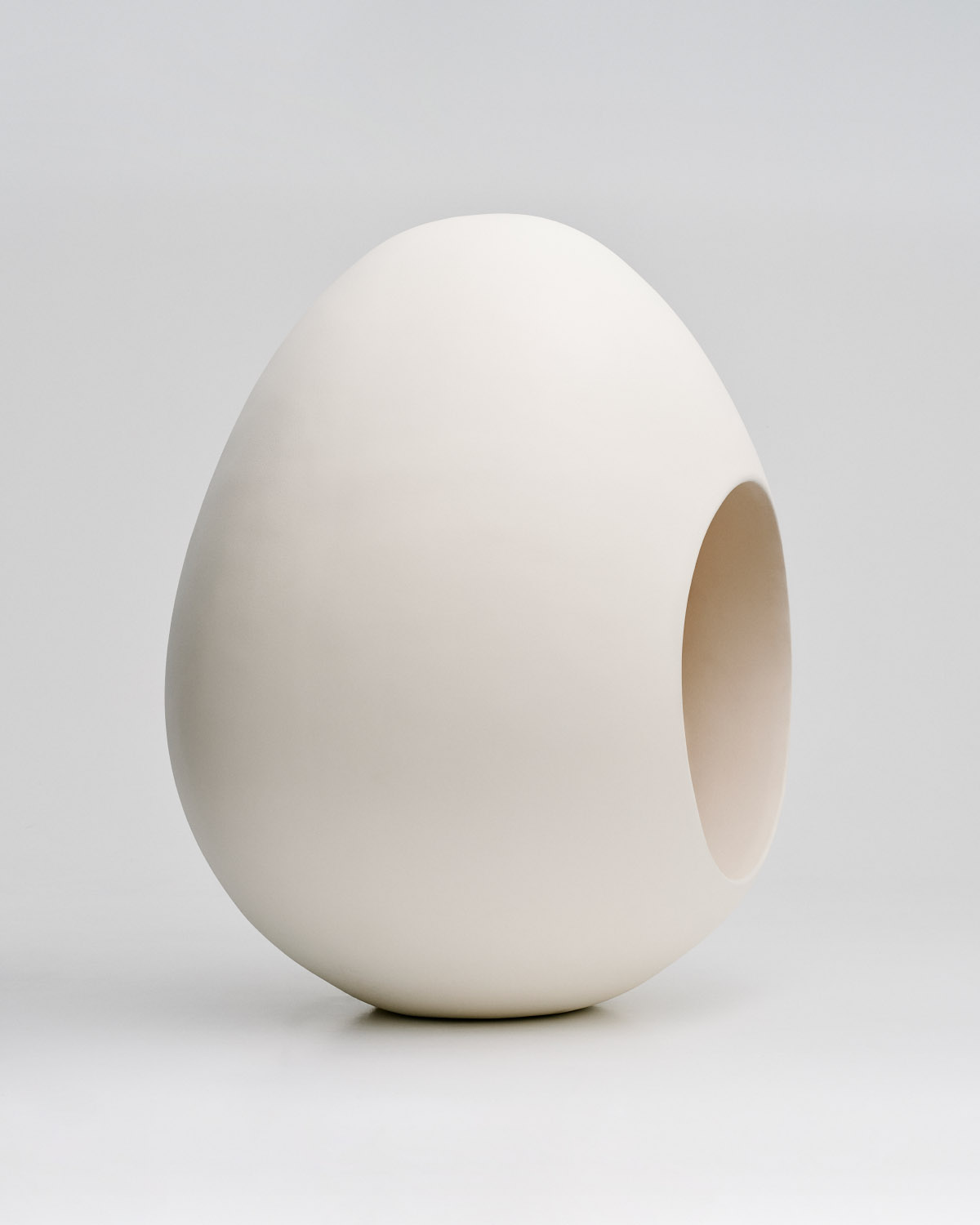
The second work, CAPPUCCINO (2025), moves from the heat of the foundry to the cool precision of the marble studio. Cut from Bianco Statuario marble, one of the most storied stones in art history, long used by masters in Pietrasanta, the work gives Reisinger's digital language a body of real stone. At 468 x 357 x 306 mm, the piece looks almost as if it were inflated or poured rather than carved. This visual paradox is central to Reisinger’s charm: he uses a material synonymous with Greco-Roman monuments to express a form that feels futuristic and soft. The work was realized by the studio of Massimo Galleni, where master carvers used rasps, rifflers, and drills to translate the digital file into a three-dimensional reality.
In CAPPUCCINO, the faint grey veining of the Statuario marble runs through the sculpted volumes, ensuring that no two pieces in the edition of 14 are identical. The marble is worked by removal, a process that is the inverse of 3D modeling where objects are built from the void. This tension between the way the form looks (additive and soft) and how it was made (subtractive and hard) creates a compelling dialogue. It is an object that sits between a drawing and a monument. By using stone that has been in the ground for millions of years to host a form designed on a screen in 2025, Reisinger collapses geological time into the digital present. It is a quiet argument for the permanence of the digital imagination.
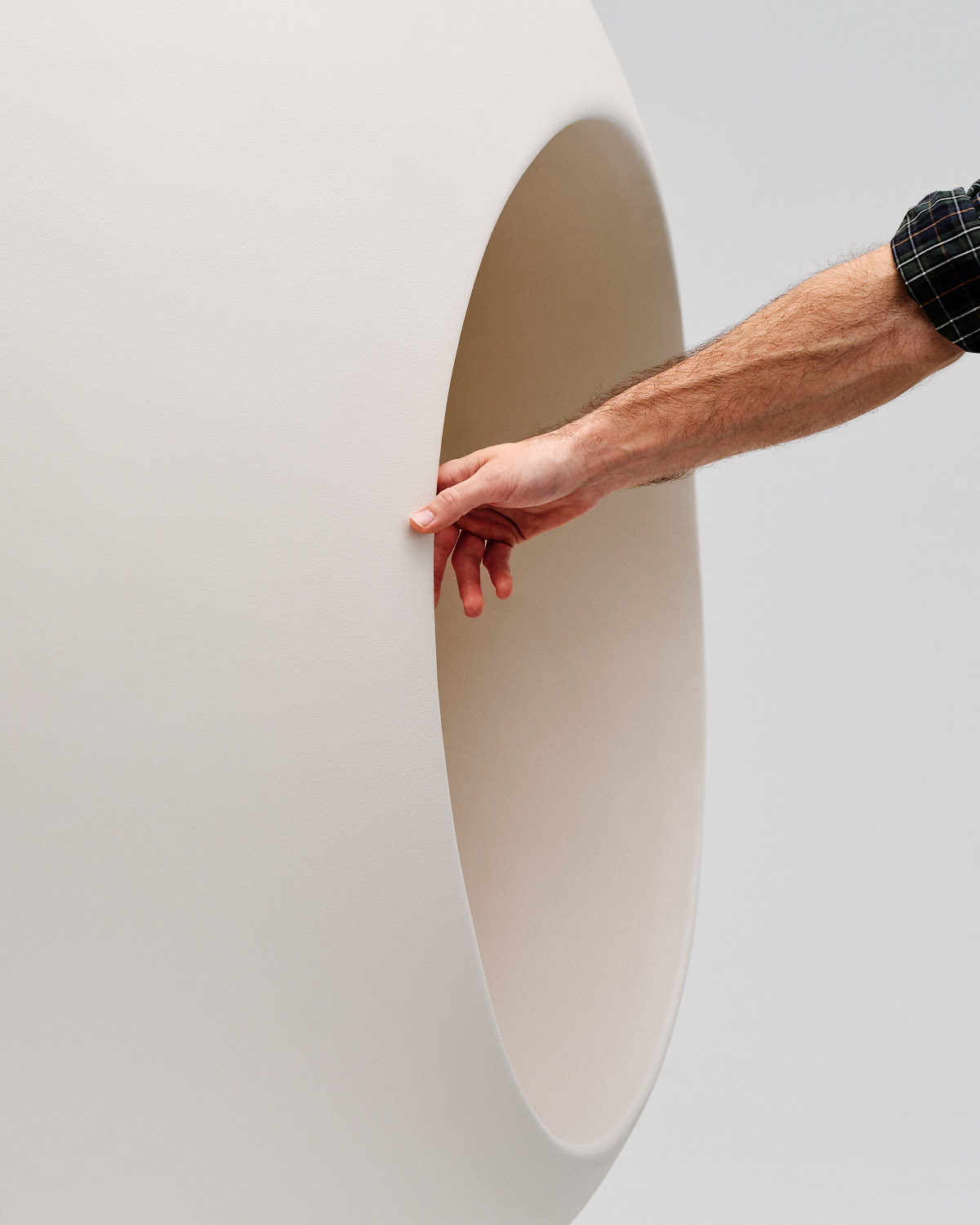
The final work, CORTADO DOBLE (2025), explores the medium of glass, a material that perhaps most closely resembles the digital screen. Glass is a substance defined by its relationship with light: its transparency, its refraction, and the way it gathers and bends the atmosphere around it. At 380 x 365 x 305 mm, CORTADO DOBLE is mouth-blown at the legendary Holmegaard glassworks in Denmark. Established in 1825, Holmegaard represents a peak of Scandinavian craft, and here their glassblowers have shaped molten glass at over a thousand degrees to match Reisinger’s signature rounded geometry. Because glass is shaped while moving and records the breath of the maker, each piece is a physical record of a specific moment in time.
CORTADO DOBLE gives the digital form a quality it never possessed in the computer: the ability to distort the world through its body. As the light in a room changes throughout the day, the glass object responds, mirroring the shifting environment in its surfaces and depths. The title, referring to the everyday ritual of coffee, anchors the work in the domestic and the familiar. It is a highly sophisticated object that nonetheless seeks to participate in the simple moments of life. By choosing glass, Reisinger highlights the fragility of our perceptions. The work is at once solid and seemingly invisible, a physical ghost of a digital thought that has finally found its way into the light of the real world.
Coda: The End of Alternatives
Andrés Reisinger’s collaboration with Edition Solenne is more than a collection of beautiful objects; it is a manifesto for a new kind of materiality. In a culture that is increasingly anxious about the 'unreality' of the digital age, Reisinger’s work provides a grounding resonance. He proves that the beauty we find in virtual spaces is not a hallucination, but a legitimate extension of our human desire for form and meaning. By bringing these shapes into bronze, marble, and glass, he ensures that they survive long after the screens are turned off. He reminds us that the world is not determined by alternatives, we do not have to choose between the pixel and the stone. We can have both, and in their meeting, find something entirely new.


